[ccfic]
Jim White
23rd October 2025
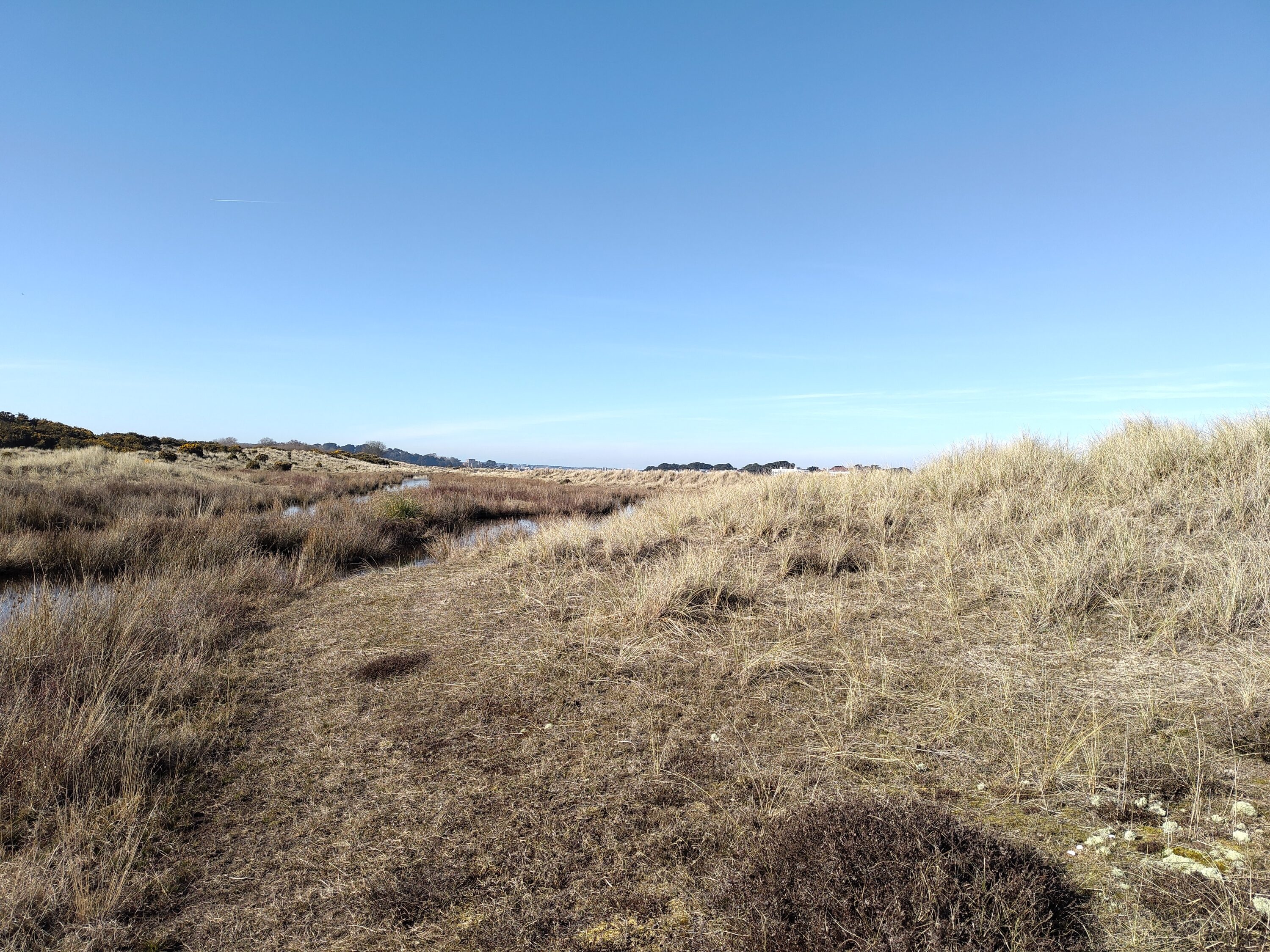
The decision on whether to go ahead with our plan to visit Brownsea effectively was taken for us when it was announced on the Weds afternoon that the island would be closed on Thurs due to the forecast storm. Instead, and with the detail of the forecast suggesting that the worst of the rain should have passed by morning, a small band of four decided to go out anyway, this time on a second visit to Studland dune slacks. In fact the day wasn’t bad, with only one short shower and, at least in the shelter of the dunes, the wind quite manageable.
Our search area this time was the dune slack E of Second Ridge N, and to reach a fair way along the slack we travelled through the dry heath of the ridge. The consistent dry heath bryos include Hypnum jutlandicum, Polytrichum juniperinum, Campylopus introflexus, C. pyriformis and Dicranum scoparium. Two more scrapes in wet heath were explored but again there is no trace of Fossombronia here. Gradation from dry into permanently wet is sharper and so the extended drawdown zone exposed in our first scrape of last week is not repeated. The Sphagnum that is colonising most readily appears to be S. auriculatum, with some S. cuspidatum in the deeper pool.
Difficult terrain of dense and deep Molinia tussocks concealing gullies of unknown depth, along with stands of gorse separate the new scrape from the main slack, but here the vegetation is much more agreeable. The age of the sallows in the slack N of the main track is significantly greater than on the S side explored last time. As a result there is a more luxuriant epiphyte cover and the heavier shade cast by the trees has resulted in much weaker Molinia, with these tussocks also more effectively grazed. Mnium hornum characteristically forms the top cover giving way to a zone of Pellia epiphylla in the lower section of a tussock. A community occupying the vertical shaded and humid tussock sides includes Calypogeia fissa, C. arguta, Cephalozia bicuspidata and C. connivens. Organic debris of old leaves on the damp floor can support other liverworts such as Lophocolea bidentata and L. heterophylla and also the uncommon Riccardia palmata. Rather untypically there is a small amount of Eurynchium striatum, while Calliergonella cuspidata, Calliergon cordifolium and Plagiomnium undulatum occupy shallow wet hollows.
Further Sphagnum spp in the wet woodland include much S fimbriatum, along with S palustre and S subnitens and some S squarrosum. Within these growths the liverworts Kurzia pauciflora and Odontoschisma sphagni are present. Occasional in the bryophyte cover over rotting stumps or moribund tussocks is the tiny moss Aulocomnium androgynum, while much more abundant is Kindbergia praelonga.
Hypnum cupressiforme is the most abundant epiphyte, with H andoi and around the lower trunks, Isothecium myosuroides. Other occasional epiphytes include Ulota crispa, Pulvigera lyellii, Dicranoweissia cirrata, Bryum capillare, Zygodon conoideus, Z viridisssimus, Frullania dilatata, Metzgeria furcata, Myriocoleopsis minutissima, Microlejeunea ulicina and Dicranum scoparium. One large fallen but still live sallow has a good growth of Frullania tamarisci. The drier bank running along the length of the old cut – the main flow out from Little Sea – provides humid but slightly drier conditions and joining the bryophyte flora here is much Leucobryum glaucum, with Sphagnum compactum, Polytrichum formosusm, Dicranella heteromalla and unusually very locally, on rotting wood, Brachythecium rutabulum.
Good to have rescued a ‘right-off’ day to explore another part of the dune slacks. Grazing pressure seems to be improving especially under the sallow cover. Water levels weren’t as low as expected today though, probably due to surface water from the heavy rain of the preceding night. The northern ‘Central Marsh’ is more accessible than its southern section despite this.
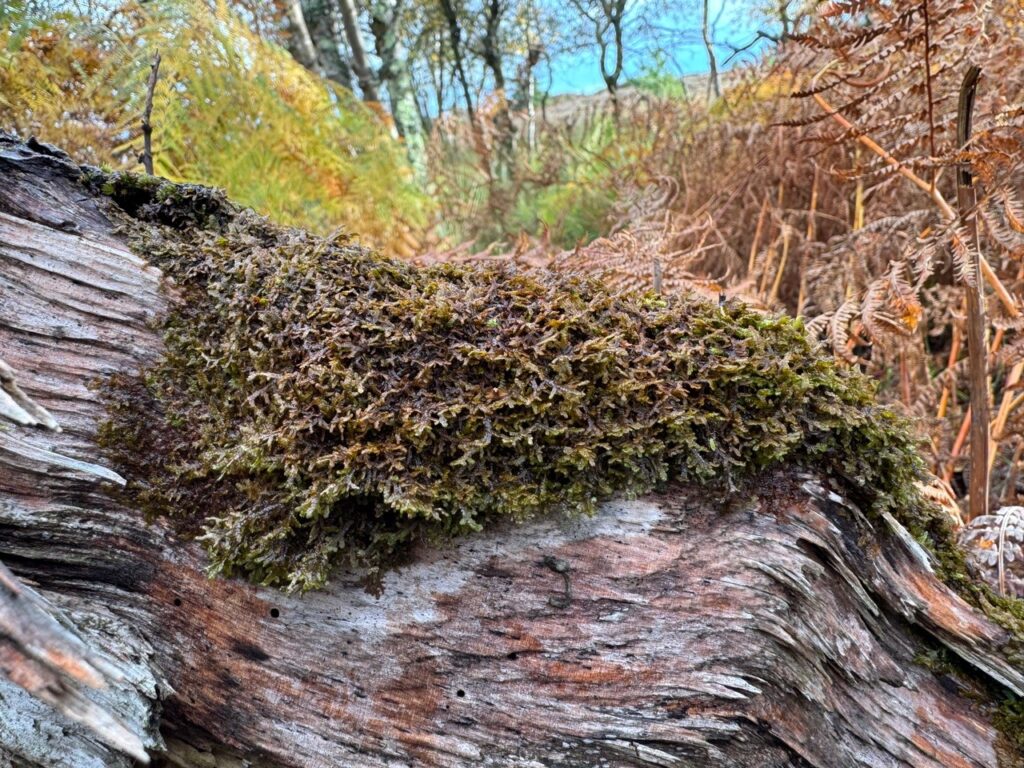
Frullania tamarisci on fallen sallow trunk. Lynne Goble