[ccfic]
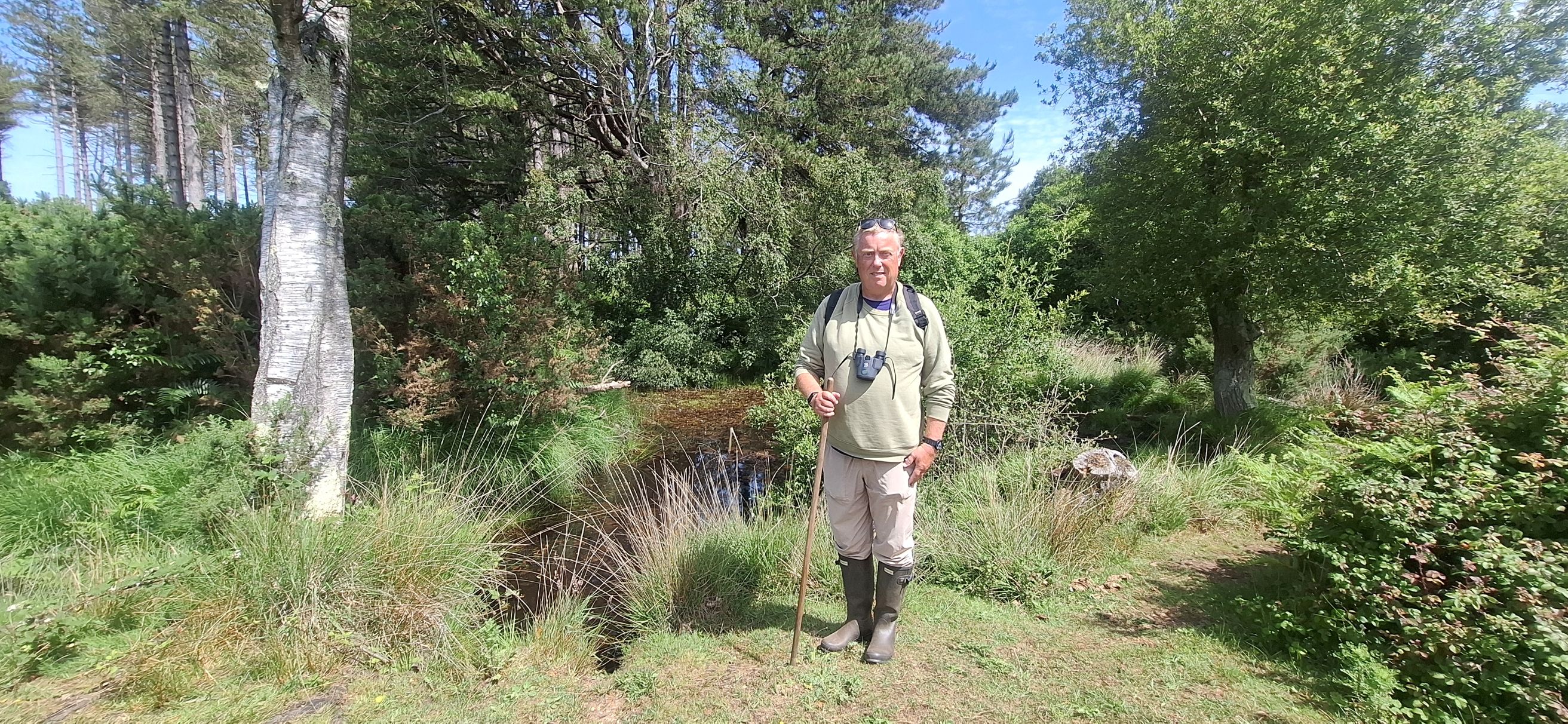
In each newsletter, Meet the Forum will introduce you to one of the people behind the scenes or out in the field—those who bring energy, expertise, and enthusiasm to our shared work. this time we spoke to one of our newest members, Steve Gilbert.
How did you first become involved with the Purbeck Natural History Forum?
Having recently retired from teaching and having a love of natural history I was searching the internet for possible opportunities to develop my interests in natural history and wildlife, especially in the local environment. PNHF came up, which on further reading seemed to fit the bill, an opportunity to be trained, develop both identification skills and ecological recording skills while providing data for long term monitoring of the wildlife in the Purbeck area. I signed up for the lichen group, which was a group of organisms that I hadn’t really looked at before. This proved to be so interesting, not only in the identification work, but the opportunity to meet extremely knowledgeable like minded people.
What first sparked your interest in natural history, wildlife, or ecological recording?
I am told that my interest in wildlife started when I was 6 or 7 and had a bad eye injury that meant sitting still for several weeks. Some bird food was bought and a teacher gave me a bird book. Many happy hours were spent watching the birds come and feed in the garden. This then lead to an interest in butterflies, which lead onto plants. I was extremely lucky in that up to the age of 11 we lived on the edge of a huge park and disused railway line and my parents took us out at every opportunity. All through my life I have been involved on and off with various ecological recording, such as butterfly surveys or surveying bridges for bat roosts and been privileged to share this interest through teaching Biology for over 35 years.
What types of surveys, recording, or conservation activities are you currently involved in?
Prior to joining PNHF I was doing a transect for UKBMS, which I am still doing each summer. I also complete a WeBS count every month on the River Frome. Since joining PNHF I have joined the lichen group, Dragonfly and Damselfly Recording Group, Pond Survey and undertaking a survey for the Heathland breeding bird survey. This sounds a great deal but in reality it means doing something linked to ecological recording twice a week.
Are there any particular species, habitats, or places you feel especially passionate about, and why?
This has always been the environment in which I live or have lived, so I am extremely passionate about the wildlife of Dorset in particular the Purbecks and Poole Harbour. Added to this is that southern England is really a frontier for many northern European Species and Southern European species, so by studying and understanding the trends in the species in these areas is giving us an insight into the effects of global warming. The lowland heathlands of the UK equate to roughly 20% of the entire lowland heath in Europe, making it a critical conservation priority (JNCC,UK).
Why do you think the work of the Purbeck Natural History Forum is important, both locally and beyond Purbeck?
The PNHF is allowing a great deal more data to be collected than would be the case otherwise, which is allowing trends and patterns to be seen that are being used to inform how the land is managed. What is also great about this is that this is shared with the volunteers who are collecting this data, which is very motivational on a personal note.
The PNHF is allowing a large number of individuals, many of which live in the area, to get out collect data and therefore be actively involved in the local environment, which can only be good for the individuals and conservation in the area.
As a member of PNHF we are given training to develop skills for effective recording, while always considering the environment.
Having listened to many conversations it appears that other land owners outside Purbeck are interested in what is happening, which can only be good for conservation in a wider context.
What advice would you give to someone who is new to biological recording or conservation volunteering?
Try it. With a group such as PNHF there is so much knowledge available which people are really happy to share. Sometimes you may feel overwhelmed, but stick with it as there will always be support and a great deal of encouragement. Try it even if you feel you know nothing-I knew very little about lichens, but it has been interesting and fulfilling learning the little bit I have done so far. If you are doing anything in mires or ponds a big walking stick and good wellies. A handlens for anything small, close focus binoculars for insects and binoculars for birds.
If you could spend a day surveying anywhere in the world, where would you choose, and what makes it special to you?
Recently I visited some of the temperate rainforests on Dartmoor, and probably as a result of the lichen group, I would love to spend some time with a real expert looking at the lichens. Having grown up with all the campaigns about saving tropical rainforests, little did I know we had our own, much more threatened rainforest, which I could visit and study virtually on my own doorstep.