[ccfic]
Jim White, Thurs 19th February 2026
A return to Arne this week to explore the North part of Salterns Copse. Six moss hunters made it, on a rather grey day, dry but with a brisk wind that made it feel chilly, a condition periodically heightened when occasional brief thinning of the cloud allowed a couple of seconds of warmth to reach us. Salterns is recorded as Ancient Woodland, and it is an irregular shape and enclosed by old banks, and there are no signs of the small former enclosures in the southwest part of the woodland we visited before. If it is an ancient site though it will have been felled and replanted; many conifers are still scattered and there is a significant stand of almost pure sweet chestnut, again obviously planted at some stage. At the northeast end however there are some veteran oaks that perhaps give a hint of the wood’s former character.
Much of the wood is probably dry in normal conditions, but after such a prolonged wet period there is widespread surface water. More permanently wet conditions prevail with ditches along the west & east boundary banks; in several circular ponds (probably WWII bomb craters); and in particular in several seepage lines, draining east towards the transition of the woodland to the marshes of Slepe Moor. As with the adjoining heathland, livestock have access to the wood, and the activity of pigs is especially noticeable with much rooting through leaf litter and humus. Somewhat unwelcome however is significant disruption of the carpet of Leucobryum glaucum agg, and in the seepages, Sphagnum palustre, S. fimbriatum and S. auriculatum. Salterns has experienced locally frequent wind blow, with a number of the tall chestnut trunks leaning or fallen, with resulting root plates upturned. There are also several piles of cut wood, some showing partial bonfire activity. These random fire patches support a carpet of Funaria hygrometrica and some Ceratodon purpureus. The rotting wood has a luxuriant cover of mosses including Hypnum cupressiforme, Isothecium myosuroides and Brachythecium rutabulum. Other common mosses of the woodland floor include Kindbergia praelonga, Pseudoscleropodium purum, Mnium hornum, Polytrichum formosum and occasional Thuidium tamariscinum and Hylocomiadelphus triquetrus.
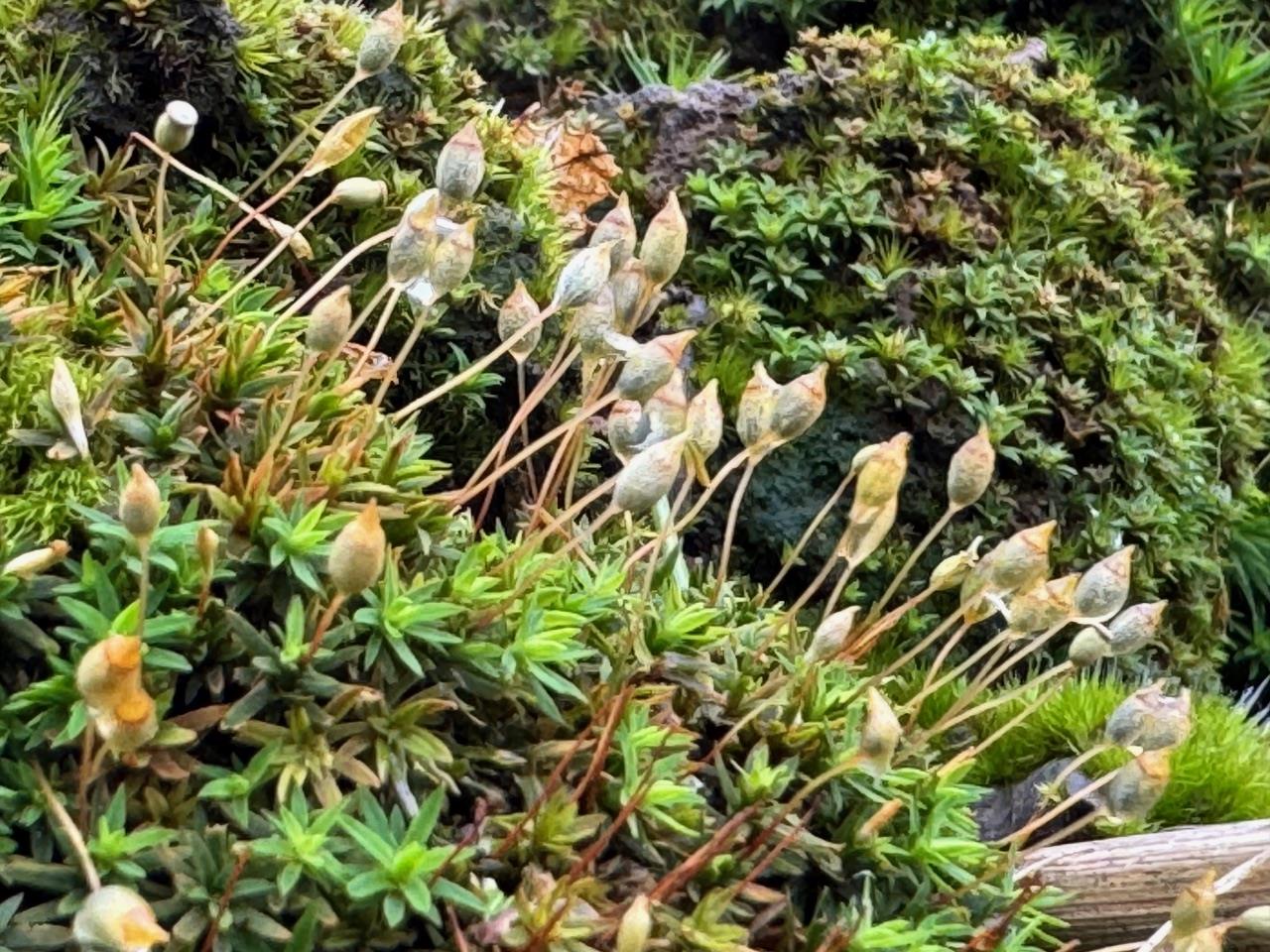
Vertical banks, especially where shaded and humid, support mosses such as Fissidens bryoides, Pseudotaxiphyllum elegans, Tetraphis pellucida and several liverworts including Calypogeia fissa, C arguta, Cephalozia connivens, Lophocolea bidentata, L. heterophylla, Diplophyllum albicans and Lepidozia reptans. An old partially rotten stump supports a striking cover of the very local Odontoschisma denudatum, conspicuous despite its small size by the dense spangling of very many gemmiferous tips. Similarly a single rather unremarkable birch tree has a good cover of Frullania tamarisci, while other regular epiphytes occur more widely, including F. dilatata, Metzgeria furcata, Hypnum andoi, H. resupinatum, Dicranum scoparium and Lewinskya affinis. The upturned root plates of wind-blown trees provide a further habitat, supporting spp such as Atrichum undulatum, Dicranella heteromalla, Polytrichum juniperinum, Orthodontium lineare, Campylopus introflexus (inevitably), and locally Pogonatum aloides. A small rowan, in the transition zone between woodland and open heath and mire, has a particularly rich epiphyte flora with additional species including Plenogemma phyllantha, Pulvigera lyellii, Orthotrichum pulchellum, Dicranoweissia cirrata and Zygodon rupestris.
A brief exploration of a small part of the nearby mire of Coombe Heath was limited by time and also excessive standing water. Additional species here though include Sphagnum compactum, S. tenellum, S. cuspidatum, S. subnitens, S. pulchrum, Aulocomnium palustre and Odontoschisma sphagni, and in the dry heath fringes Pleurozium schreberi.
Picture above: Pogonatum aloides with capsules, growing on a root plate, by Lynne Goble