[ccfic]
Jim White
Thursday 6th November 2025
The intended second visit to Brownsea didn’t happen today as there was a clash with the annual red squirrel census. We may have needed to be a bit too constrained in our roving or, even worse, a wandering band of moss hunters could have unwittingly compromised the count. Instead the six who could make it this week returned to Studland dune slacks, this time, exploring the north end of Central Marsh slack, to the East and South of the old Northern Enclosure. The primary habitat is wet sallow and birch woodland, fringed by wet and dry heathland. Particular features within the wooded habitat are, in some places, the size of venerable old sallows that typically collapse but continue to grow, providing horizontal trunks thickly clothed in epiphytes; and the abundance of old Molinia tussocks, with the grass suppressed by shade and effective grazing, so that with less competition the humid tussock sides often hold good bryophyte cover.
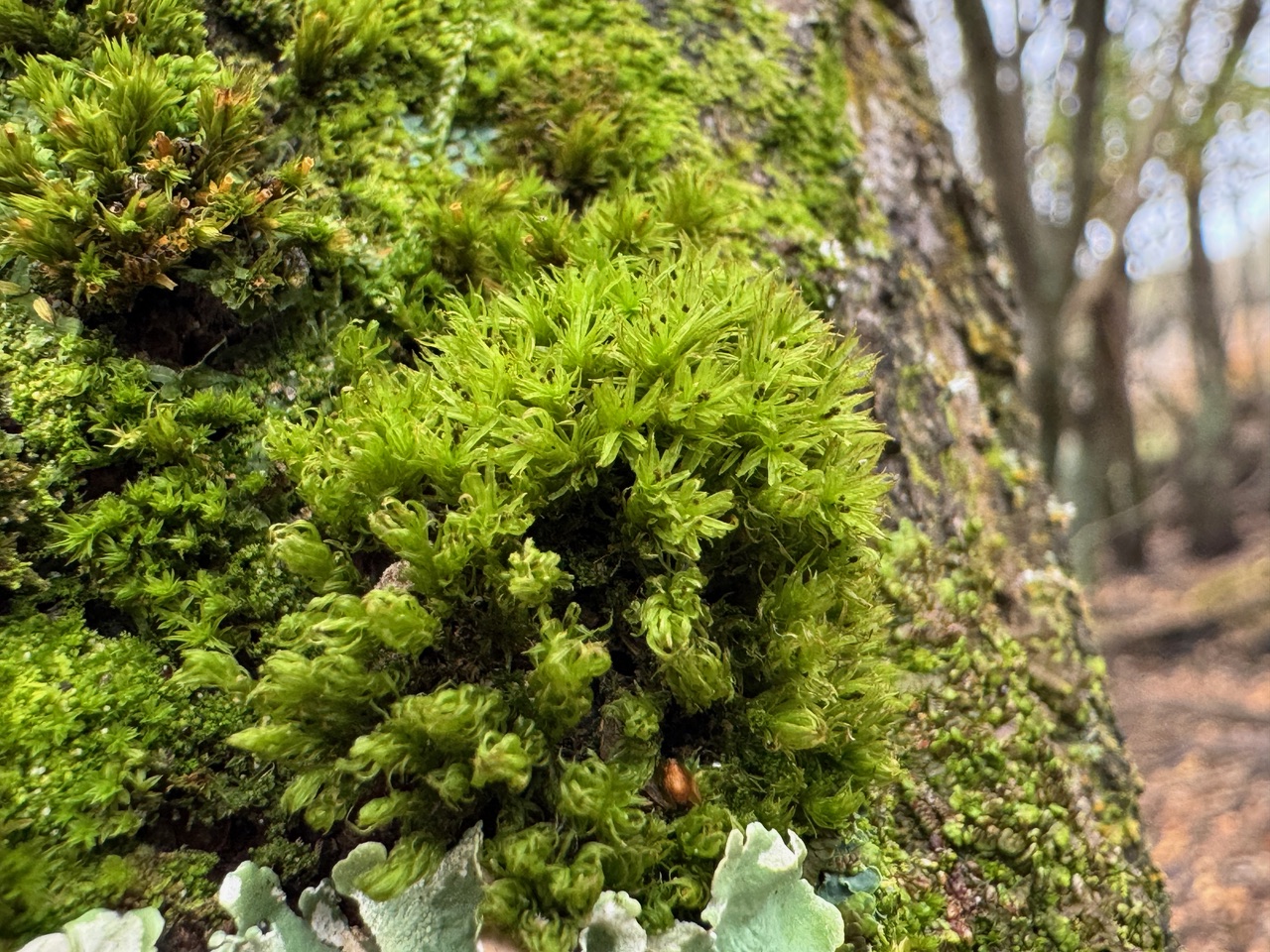
The most ubiquitous epiphyte on the sallows is Hypnum cupressiforme but there is also a notable abundance of H. resupinatum here. Other epiphytic bryos include H. andoi, Amblytegium serpens, Isothecium myosuroides, Metzgeria furcata, Frullania dilatata, Lewinskya affinis, Ulota sp, Pulvigera lyellii, Zygodon conoideus and much more occasionally, Plenogemma phyllantha and Metzgeria consanguinea. The drier tops of moribund tussocks again hold a cover of Mnium hornum, with Pellia epiphylla typically clothing the lower sides, but in both cases rather less consistently than further S in the slack. Other liverworts on the moist shaded sides of the tussock columns include Calypogeia fissa, C. muelleriana, C. arguta, Cephalozia bicuspidata, C. connivens, Lophocolea bidentata, L. heterophylla and, on rotting leaves and stems, Riccardia palmata.
It is clear from the dark staining and the absence of epiphytes on the lowest 0.5m of tree bases, that the whole slack floor must be inundated for long periods. Several Sphagnum mosses occur in this habitat, such as S. fimbriatum, S. auriculatum S. subnitens and S. palustre, and again there is a notable abundance of Calliergon cordifolium as well as Calliergonella cuspidata. Near the central main watercourse, perhaps where the water is less affected by the adjoining heathland, a few more bryos typical of less acid habitats occur, such as Drepanocladus aduncus in its long ‘streamer-like’ form, draped over trunks that must often be submerged, Pellia neesiana, and the nationally scarce Kandea elodes.
Our route also took us across several areas of open heath where additional species include, in the dry areas, Hypnum jutlandicum, Polytrichum juniperinum, Campylopus introflexus, Dicranum scoparium, Pseudoscleropodium purum, Kindbergia praelonga, Thuidium tamarscinum, and Rhytidiadlephus squarrosus, and in wet heath, additional Sphagnum species including S. cuspidatum and S. compactum. A final pause, near the end of our sorties and in dune heath rather than the main slack, a damp hollow (SZ0370386068) has a small amount of the very local fern ally Lycopodiella inundata, while the open damp peaty surface supports several liverworts including Gymnocolea inflata, Riccardia chamaedryfolia, and in a second dune location, the nationally scarce Fossombronia foveolata.
(Photo: Epiphyte community on old sallow, including Plenogemma phyllantha – Lynne Goble)