Summary of discussions
This document summarises the main points discussed during the PNHF Member Consultation Meeting held on 21 January 2026. If you have any further comments or suggestions after reading the summary, please feel free to get in touch with either Debbie (Admin@purbecknaturalhistory.org.uk) or Jasper (Jasper@purbeckecology.org.uk).
1. New PNHF organisational structure
In November 2025, the PNHF Committee approved a new organisational structure for the Forum. An overview of this structure is provided below.
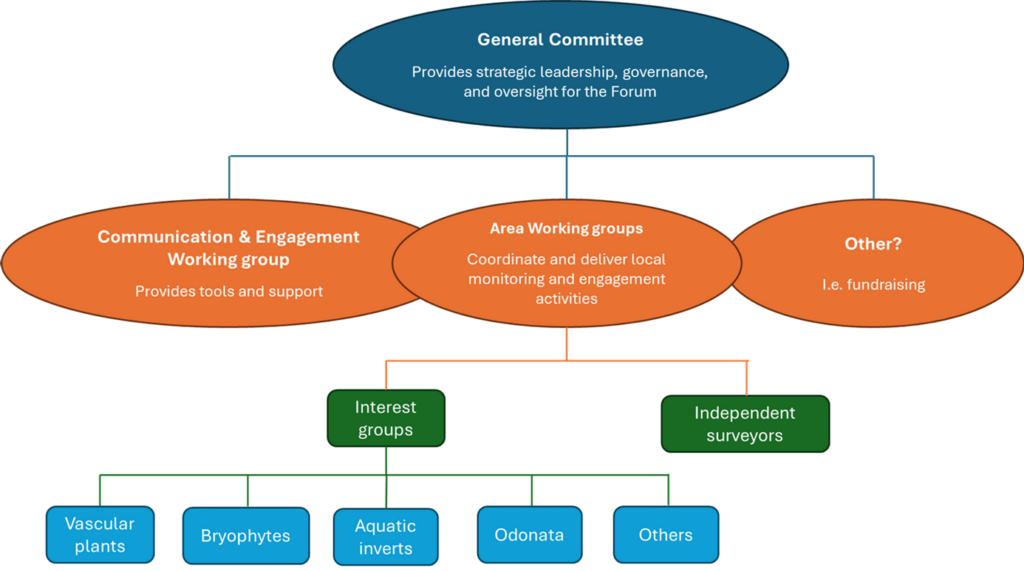
At the top of the structure sits the PNHF Committee, which provides overall strategic direction for the Purbeck Natural History Forum. The Committee ensures that the Forum’s activities align with its aims and objectives as set out in the constitution. It supports the various working groups by providing guidance, oversees decision-making, and represents the Forum externally.
The Committee consists of representatives from landowners in Purbeck who make use of the Forum, alongside volunteer members, and meets three times per year.
Reporting to the Committee are several Working Groups, most notably the Area Working Groups. These groups are responsible for delivering the Forum’s monitoring and engagement activities on the ground within defined geographical areas (for example, Purbeck Heaths NNR and Wareham ARC). They act as the operational link between the Forum’s strategic direction and its practical implementation. Responsibilities include coordinating surveys, supporting volunteers, managing data, and sharing local knowledge to inform Forum-wide priorities.
Area Working Groups are made up of landowner representatives, the PNHF Project Officer, and volunteers. In addition, there is a Communications Working Group, which focuses on Forum communications.
The Forum also hosts a number of Interest Groups, which provide an organisational platform for members who share a particular ecological interest. Interest Groups are listed on the Forum website, and members may join one or multiple groups. Members receive updates about relevant events and activities and have access to shared resources.
There is currently no dedicated Fundraising Working Group. Fundraising is recognised as an important priority for the Committee, but as the Forum is an unincorporated association, it cannot raise funds directly. Instead, fundraising is undertaken through partner organisations.
Participation and communication within Interest Groups
A question was raised about how many people take part in activities through specific Interest Groups and how members stay in contact with one another.
The image below provides an overview of the number of members per Interest Group. However, this can be misleading, as not all registered members are actively involved. Of the Forum’s approximately 360 members, it is estimated that around 80–100 actively participate in surveys, events, or other activities.
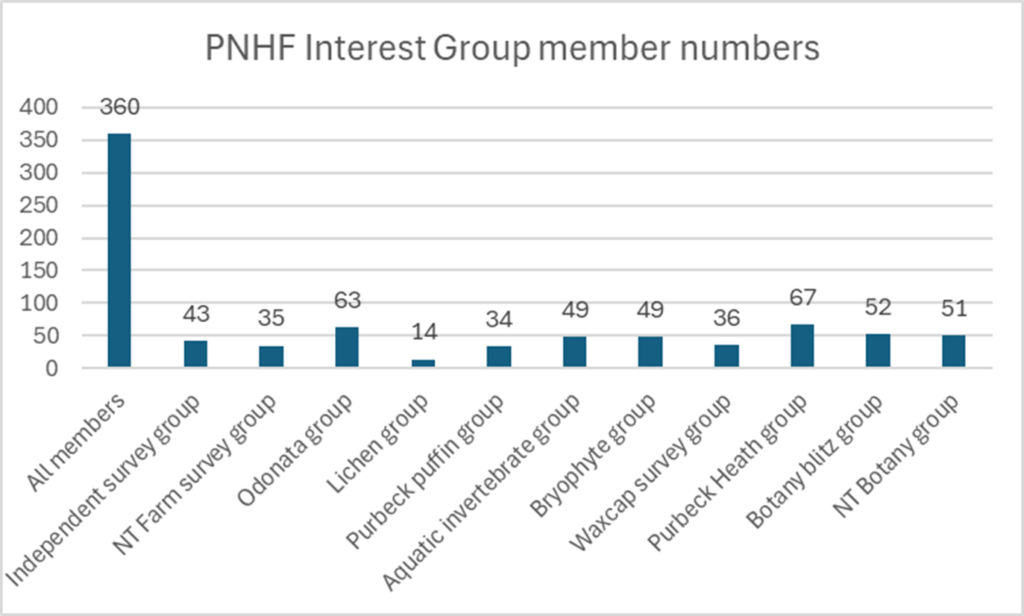
To gain a clearer picture of active engagement, all members will be contacted in the coming months and asked to update their subscription preferences. This process is expected to reduce the overall number of registered members but will provide a more accurate reflection of active participation and interests.
Currently, the main way Interest Group members connect is through events and activities. With the launch of the new Forum website in February, members will also be able to contact each other directly through the website.
Some Interest Groups may choose to enable the option for members to respond directly to group updates or events. Any discussions would require moderation by the group owner or administrator, and as time capacity can be limiting, this decision rests with the relevant group leads.
The Forum also has an unofficial WhatsApp group used by some members to share records and events. This group is not formally promoted, as it does not currently comply with GDPR requirements.
2. Communication with Forum members and the website
Members generally feel that event descriptions are clear and that they are informed in a timely manner about upcoming activities. The main area identified for improvement relates to the automatically generated emails from the website, particularly those linked to group updates.
Issues raised include:
- Emails can appear spam-like.
- Subject lines and content are not always clear.
- “Read further” links often lead to pages that repeat the email text.
- Members receive a high number of unnecessary notifications (e.g. multiple emails about resources being uploaded or deleted).
As a result, it is not always clear which emails are important and which can be ignored.
A full website overhaul is planned for February, and addressing these issues is a key priority. The aim is to significantly reduce (ideally eliminate) unnecessary automated emails and to improve the clarity, relevance, and appearance of essential messages so they are less likely to be perceived as spam. This will be reviewed with members once the new website has been in use for some time.
Members would also appreciate receiving a confirmation email after signing up for an event, ideally including a link to add the event to a digital calendar. This will be explored as part of the website upgrade.
It was noted that not all members may be aware of the Groups and Events sections of the website. When people sign up as Forum members, they receive only general Forum emails. Updates about surveys and events are only sent once a member has joined a specific Interest Group. It was suggested that this information be included in a welcome email, which will be followed up.
Feedback from surveys
Members expressed a desire for more feedback from surveys, such as summaries of results and the impact of their work. Some groups already do this well (e.g. the Bryophyte Group, NT Botany Group, and Waxcap Group). Time constraints for survey leaders are often the main barrier.
It was suggested that feedback could also be provided by another group member who attended the survey, rather than solely by the survey leader. This approach will be encouraged.
Other suggestions included:
- Showing how many people have already signed up for an event (to be explored during the website redevelopment).
- Exploring GDPR-compliant ways to facilitate car sharing, recognising that survey leaders generally do not have the capacity to organise this.
The Forum will also launch a quarterly electronic newsletter within the next few months.
The unofficial WhatsApp group allows members to share observations or ask questions. As it does not meet GDPR standards (members can see each other’s phone numbers), it remains unofficial. Members who wish to join can contact Jasper at Jasper@purbeckecology.org.uk.
Finally, members suggested adding a website section featuring relevant publications and regional news articles. This was widely supported and will be explored as part of the website redevelopment.
3. Use of the Independent Survey Group
The Independent Survey Group was launched in May 2025 to facilitate surveys not organised by partner organisations. These surveys are often better suited to small groups or individuals and are more flexible, as they can be carried out when conditions and volunteer availability allow. The concept was discussed at the previous consultation meeting and was well received.
However, uptake remained relatively low. During the meeting, several reasons were identified:
- Not all members were aware of the group.
- The launch in May coincided with an already busy survey season.
The Committee acknowledged that the timing was not ideal and agreed that the group should be promoted earlier in the year (e.g. March). This will be implemented in 2026.
There was also confusion about the role of the Lead Surveyor, particularly regarding responsibility for risk assessments. It was clarified that:
- Volunteers conducting independent surveys are responsible for completing their own risk assessments.
- The Lead Surveyor was incorrectly perceived as being responsible for others’ risk assessments.
To address this, the term “Lead Surveyor” will be replaced with “Survey Contact”. This role is simply a point of contact for questions about a survey and does not carry responsibility for others’ risk assessments.
It was agreed that members need to be better informed about their responsibility for risk assessments when undertaking independent surveys. While this requirement is included in the membership conditions, many members may not read or remember this information. The Forum will therefore:
- Place greater emphasis on communicating risk assessment responsibilities.
- Explore sending an introductory email when members join a new group, outlining the group’s purpose and expectations (including risk assessments).
4. Announcements
The following announcements were made:
- A Spring Meeting will be held on Tuesday 24 March, from 7:00 pm, at Furzebrook Village Hall. This shorter meeting will present the 2026 programme and include reflections on survey results from 2025.
- The Wednesday Group will focus largely on pond surveys in the grazing unit this year, but there will also be other surveys such as bare ground surveys at Rempstone and, Southern Damselfy surveys and fungi surveys.
- The Botany Blitz Group will return, conducting monthly Botany Blitzes on the Purbeck Heaths NNR.
- Heathland bird surveys will return, with a training day planned for March.
- ARC has released a new Reptile Monitoring Strategy. The Forum will continue to work with ARC, and all reptile surveyors will be invited to a presentation and planning meeting with ARC and Purbeck Heaths NNR partners.
- Training events planned include:
- Pond methodology refresher training
- Odonata training (early and late season species)
- Heathland breeding bird survey training
- Reptile training, with a focus on field identification of lizards
- Additional training to be confirmed
- Adrian Bicker provided a brief update on Living Record, noting work on a new interface that will function better on smartphones.