[ccfic]
Jim White
The first whole day excursion of the 2025/26 season attracted a good response with nine bryologists gathering along Ferry Road ready to explore some of the dune slacks at Studland. This venue was chosen to capitalise on unusually low water levels in the slacks, following such a long dry period. In several days of uneventful and rather gloomy weather, 16th October turned out to be exceptionally fine; sunny and unexpectedly warm. The bright sun has its disadvantages though, with sharp contrast between light and shade, especially in tricky terrain such as among Molinia tussocks.
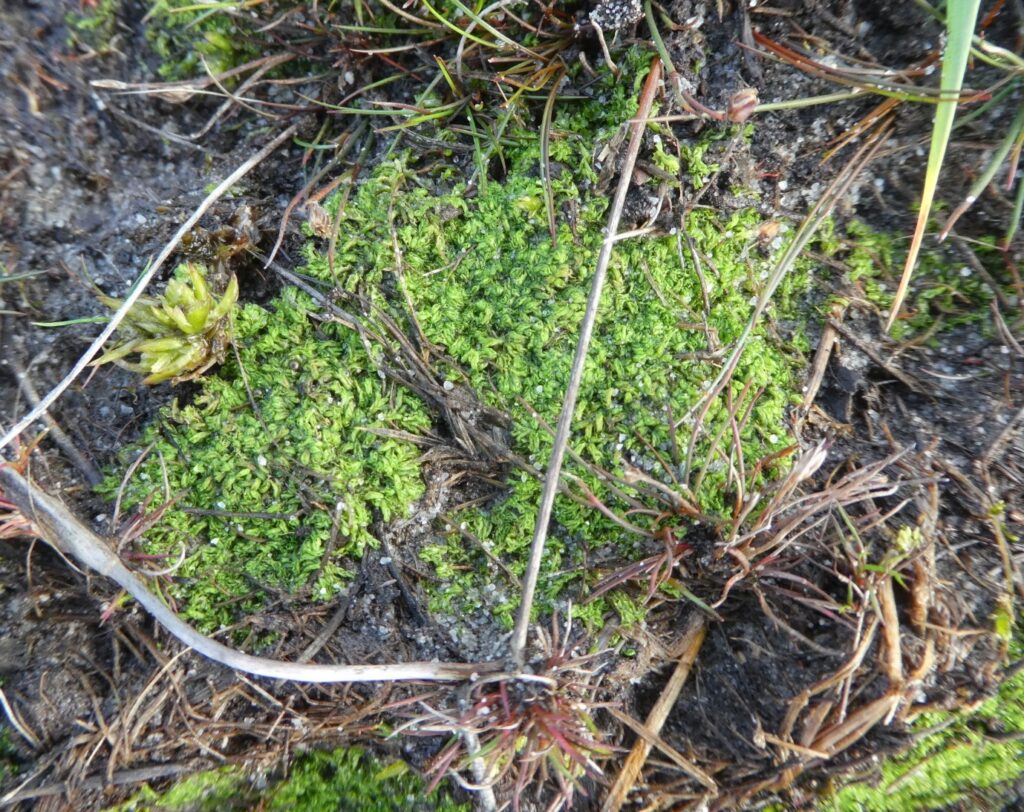
For our initial dune session the objective was to follow the W edge of ‘Second Ridge’ making sorties into the dune slack where feasible. Though water levels are not, as expected at present, particularly problematic, the rampant growth of bog myrtle proves a serious impediment to access, and in terms of habitat for bryos, is much less rewarding than old Molinia tussocks or wet woodland. Following N Boundary Track to reach our target area, we paused for a short stop to explore one of the recent (2022?) scrapes made as part of the recent ‘dunescapes’ initiative, this one close to the path and intended to provide more open conditions in part of the former ‘One Acre Pool’ slack. Steadily falling water levels in the dunes have exposed a fresh but still damp bare sand surface here with as yet no competition. There is very locally an abundance of Fossombronia – liverworts typical of open, low-competition habitats such as with seasonally fluctuating levels. In this case, and very fortunately, the plants bore plenty of developing capsules, essential for determining species from the patterning on spores. We could not know in the field but later microscopic examination of spores revealed the liverwort to be Fossombronia foveolata, a nationally scarce species with few previous Dorset records. Although we saw a further five such scrapes in the slack along the fringes of Second Ridge, none repeated the same conditions or held any of the liverwort.
Dry heathland of the ridge supports several regular mosses including Hypnum jutlandicum, Dicranum scoparium, Campylopus introflexus and C pyriformis. Damper and humid conditions of the dune slack hold a greater variety of bryos, with Aulacomnium palustre and some Sphagnum spp in the gullies between tussocks, such as S auriculatum, S palustre and S fimbriatum. Peaty sides of tussocks and organic detritus of leaf litter is a habitat for several liverworts including Calypogeia fissa with occasional C muelleriana and C arguta, Cephalozia connivens, C bicuspidata, Lophocolea bidentata, and some Riccardia palmata.
Low willow woodland occupies extensive areas of the dune slack but although the habitat is naturally wet, epiphyte cover on trees is modest. Regular spp occur such as Hypnum cupressiforme, H andoi, Isothecium myosuroides, Ulota crispa, Lewinskya affinis, Frullania dilatata, Metzgeria furcata and Myriocoleopsis minutissima, but the trees are never thickly covered with bryos. Around tree bases there are peaty hummocks with Mnium hornum a consistent cover. Leucobryum glaucum occurs more locally and there are cushions of Sphagnum subnitens joining other Sphagna and liverworts already noted. Locally here there is Pellia epiphylla and in one spot a dense turf with Lophozia ventricosa. Near the S end of the ridge, where dune slacks merge to reach the edge of Little Sea, and conditions are more permanently wet, the range of bryos also includes Sphagnum squarrosum, Calliergonella cuspidata, Calliergon cordifolium and Warnstorfia fluitans, with Riccardia latifrons found very locally on rotting wood.
Returning along the E side of Second Ridge enabled a check on the known (and rather unlikely) locality for Sphagnum medium. This is still present in a small hollow that was kept open as an occasional vehicle track. Although not in the best of spirits perhaps due to drought, the moss continues to survive here, albeit a long way from its more regular open mire habitat. The route also passes the location where marsh fern was found in 2016. Due to the combination of an unfortunately positioned scrape and even worse, rampant bog myrtle, the fern is barely surviving; just three not especially vigorous fronds found.