[ccfic]
Jim White, 19th March 2026
Another small, but select, group of moss hunters today, for an exploration of Slepe Copse. And a very fine early spring day it was, with soft hazy sunlight and warmth that we haven’t been (and probably mustn’t get) used to! Slepe Copse both sides of the Slepe/Arne road is shown as ancient woodland but the wooded area west of the road is clearly a set of several small former enclosures, with the splendid veteran oaks and occasional beech, restricted to the old enclosure banks. East of the road – today’s visit – the core of the woodland does appear more likely as ancient. There is a much broader scatter of old trees, and the enclosing bank forms an irregular oval rather than ‘organised’ field shapes. There are trees beyond the boundary, grading into Slepe Moor marshes, and here the signs of increasing wetness are clear, with many trees standing dead or moribund over a ground cover of tussocky Molinia.
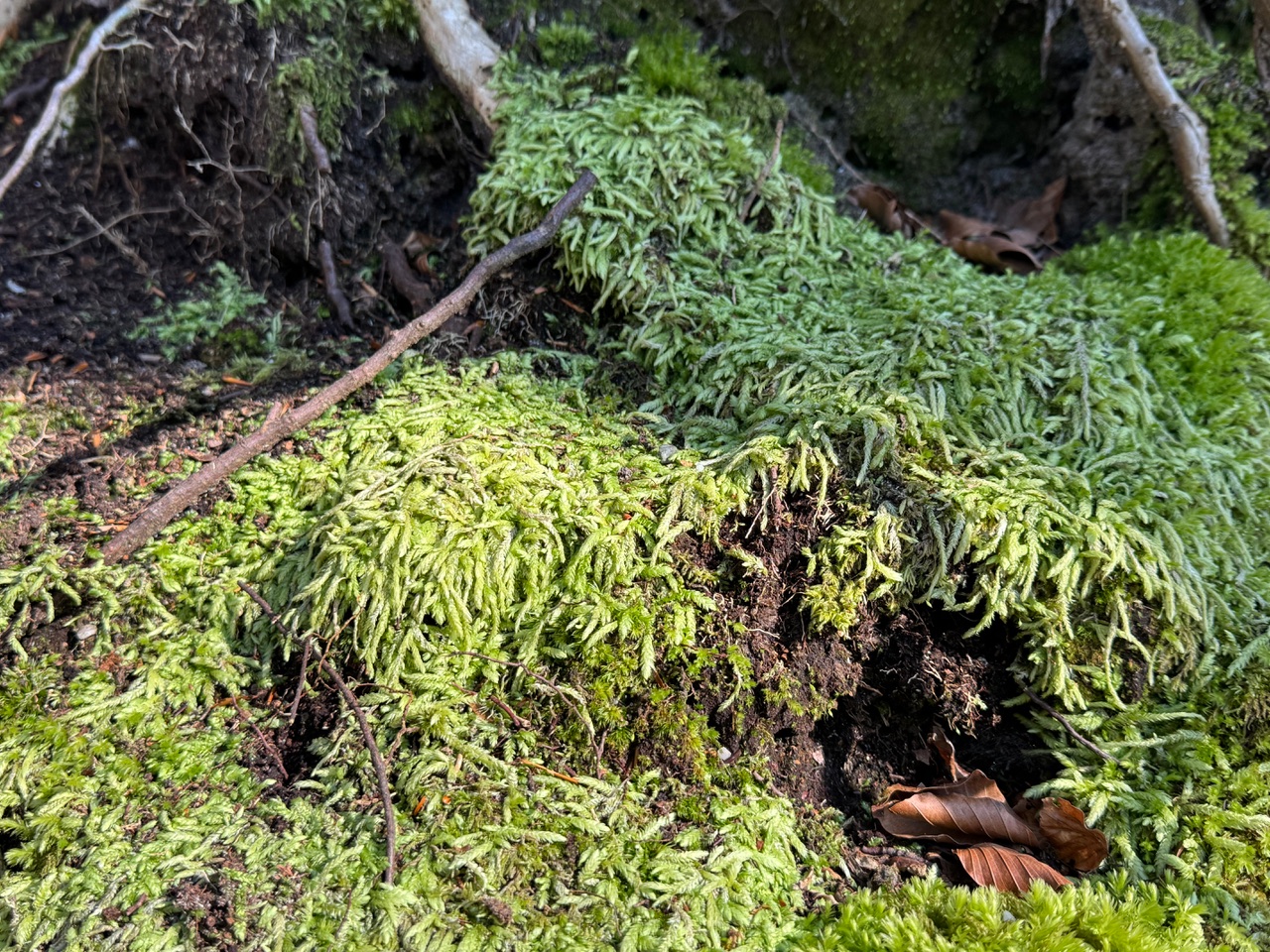
Drier banks, such as those close to the road, support an attractive mixed community of large mosses including Hypnum jutlandicum, Pseudoscleropodium purum, Pleurozium schreberi, Thuidium tamariscinum, Kindbergia praelonga, Dicranum scoparium, Polytrichum formosum, and locally Plagiothecium undulatum. Much of the flatter dry woodland floor is covered by bracken and deep leaf litter and has few bryos, but the bases of trees and fallen trunks hold a good bryophyte cover with spp such as Mnium hornum, Isothecium myosuroides, Hypnum cupressiforme, Brachythecium rutabulum, Leucobryum glaucum agg, and where shaded or more humid, Lophocolea bidentata and L. heterophylla. The main tree trunks are generally well lit and support a rich lichen flora. Epiphytic bryos are relatively restricted on these main trunks but include Hypnum andoi, H. resupinatum, Metzgeria furcata and, especially on smoother bark, Frullania dilatata. Other epiphytes on smaller branches, for instance in toppled crowns or on the occasional sallow, include Cryphaea heteromalla, Lewinskya affinis, Plenogemma phyllantha, Pulvigera lyellii, Ulota sp, Metzgeria violacea and Myriocoleopsis minutissima. In a couple of locations, one on a fallen large trunk partly lying in water and another on a living oak, there are colonies of the less frequent Frullania tamarisci.
Vertical surfaces such as root plates support Dicranella heteromalla and, especially obvious at present with its abundant capsules, Orthodontium lineare. The normally ubiquitous Campylopus introflexus appears relatively restricted at this site. Where permanently humid there is often abundant Lepidozia reptans and Tetraphis pellucida, and similarly moist conditions of old tussock sides hold spp such as Rhizomnium punctatum, Calypogeia fissa, Cephalozia bicuspidata and C connivens. These tussocks become more prevalent in the north-east part of the woodland with wetland bryos appearing, such as Aulocomnium palustre, Polytrichum commune, Sphagnum fimbriatum and S. palustre, and a pool close to the road supports a cover of S. auriculatum. The wet heath and mire between the north bank of Slepe Copse (where there is a very attractive pair of old stone gate posts with carved slots for posts), and the nearby Salterns Copse explored several weeks ago, was rather less water-logged today, allowing for further searching. Additional spp here include Sphagnum compactum, S. tenellum, S. cuspidatum, S. papillosum, S. subnitens and S. rubellum, with some Kurzia pauciflora and Odontoschisma sphagni intermingled.
There had been the thought that conditions in this relatively unexplored zone on the outer edges of Slepe Copse may provide another location for Pallavicinia found a couple of weeks ago at Big Wood, but nothing seen today quite matches that localised habitat. Here the dry banks are perhaps just too dry while the wetter areas are more dominated by tall tussocks with permanently deep wet gullies between. It’s a large and difficult area though and far from all could be examined today. Another time perhaps….
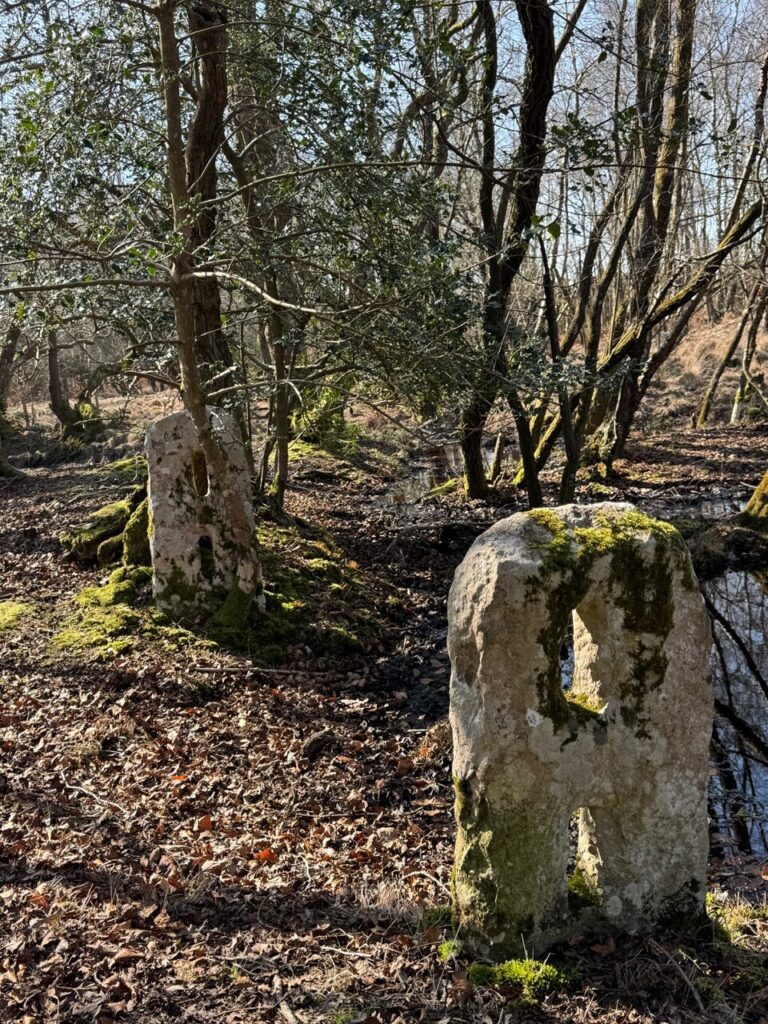
Slepe Copse, Lynne Goble
Top: Plagiothecium undulatum at Slepe Copse, Lynne Goble