[ccfic]
Jim White, 26th March
Not a bad day; dry, bright and largely sunny, albeit with a fresh breeze, but in any shelter the warmth of the sun was readily apparent. It may well have been our last group excursion of the 25/26 bryo season, so nice that there was fair weather for the seven moss hunters who assembled at the Slepe Heath gate on Soldiers Road. Our objective was to record on the adjoining Stoborough Heath, on acid grassland and the heath/mire fringes. Our first stop though was the small pond and its surrounds, close to the Slepe gate.
The pond is relatively new and signs of the spoil deposits are still discernible. The grassy sward close to the pond is dominated by Calliergonella cuspidata rather than bog mosses, and scattered widely in this turf and on the clay spoil are frequent clumps of Bryum pseudotriquetrum. Both indicate a degree of base-rich conditions, unlike the nearby typical acid heathland. B dichotomum also occurs locally and, on the sparsely vegetated clay, some Archidium alternifolium, Aneura pinguis and a little Fossombronia – most probably F wondraczechii but with no capsules, impossible to determine further.
The former fields of the NNR were entirely occupied by agriculturally improved swards 40 years ago. Heath vegetation now covers substantial areas and the remaining grassland has become a reasonable example of acid grassland with typical grass spp and a range of herbs, mostly diminutive, also characteristic of this habitat. At this early stage in the season, and with livestock grazing in place, the bryophyte component is a significant proportion of the ground cover with spp such as Pseudoscleropodium purum, KIndbergia praelonga, Thuidium tamariscinum, Brachythecium albicans, and Hypnum cupressiforme var lacunosum the principal contributors. The very shortest turf, for instance along the more trampled pathways, is the main habitat for small mosses such as Polytrichum juniperinum and Bryum spp including B capillare.
The northern edge of the dry grassland, and the extent of the original agricultural reclamation, marks a change from underlying Parkstone Sand to Broadstone Clay, producing much wetter conditions of wet heath and mire. Although reclamation probably stopped at this point there is a zone of several metres width where the current vegetation has been affected by the farming activity, not least nutrient runoff in the past, and there is now a band of birch and sallow scrub. The sallows in particular support a reasonable epiphyte flora while the ‘wet woodland’ floor has Sphagnum auriculatum and S subnitens. Epiphytic mosses include Hypnum cupressiforme, H andoi, H resupinatum, Cryphaea heteromalla, Lewinskya affinis, Ulota sp, Pulvigera lyellii, Plenogemma phyllantha, Zygodon conoideus and Orthotrichum diaphanum, along with the liverworts Frullania dilatata, Metzgeria furcata, M violacea and Myriocoleopsis minutissima. Bases of the trees and lying logs support Mnium hornum, Brachythecium rutabulum and Lophocolea heterophylla.
Away from the fringe of trees, wet heath and mire predominate, and additional spp here include Sphagnum compactum, S tenellum, S cuspidatum, S papillosum, S pulchrum, Aulocomnium palustre, and Polytrichum commune, while liverworts growing with the mosses or on tussock sides include Calypogeia muelleriana, Cephalozia bicuspidata, C connivens, Kurzia pauciflora, Odontoschisma sphagni and O fluitans. The drier heath fringes have Hypnum jutlandicum, Dicranum scoparium, Polytrichum formosusm, Pleurozium schreberi, Campylopus introflexus, and on the shallow ride-side cutting C pyriformis, Dicranella heteromalla and Pseudotaxiphyllum elegans. The furthest extent of our exploration today was the stream running from Furzebrook to Ridge, and the stream bank close to the crossing point has much Pellia epiphylla, while lower tree trunks subject to periodic inundation carry a moss typical of such silty deposits, Leskea polycarpa.
No great surprises today, but a good range of typical heathland species. It may be several months before we look closely at bryos again, as the call of the vascular plant flora is becoming increasingly pressing….
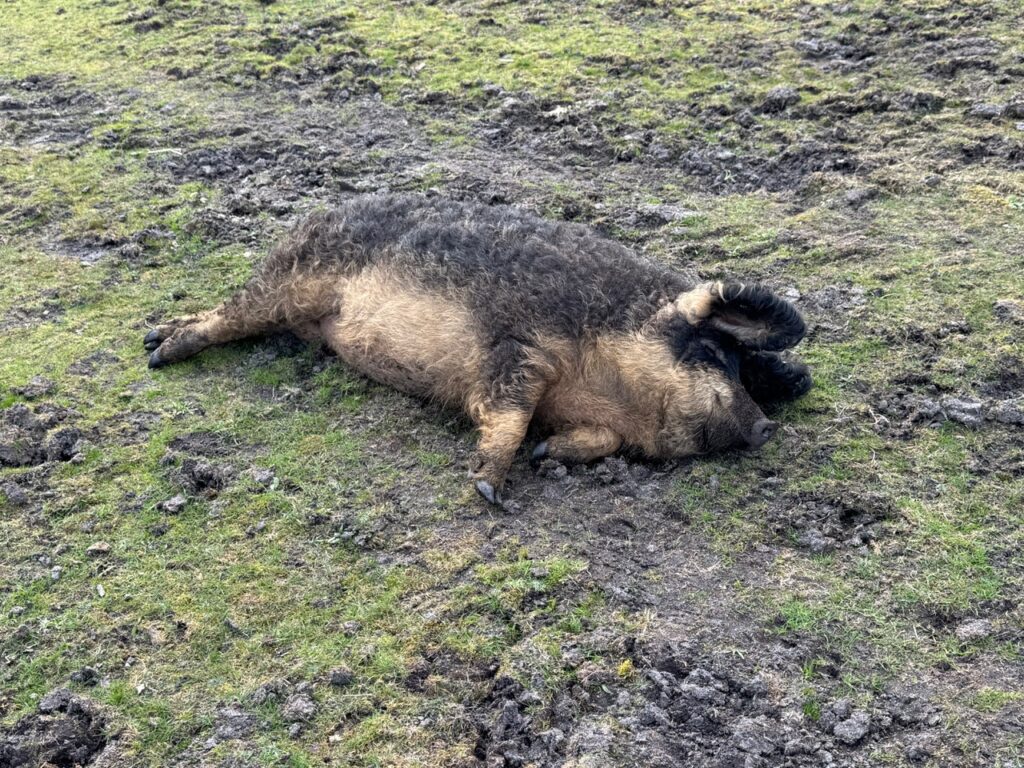
Procumbent Pig, apparently resigned to not having its tummy rubbed! (Lynne Goble)
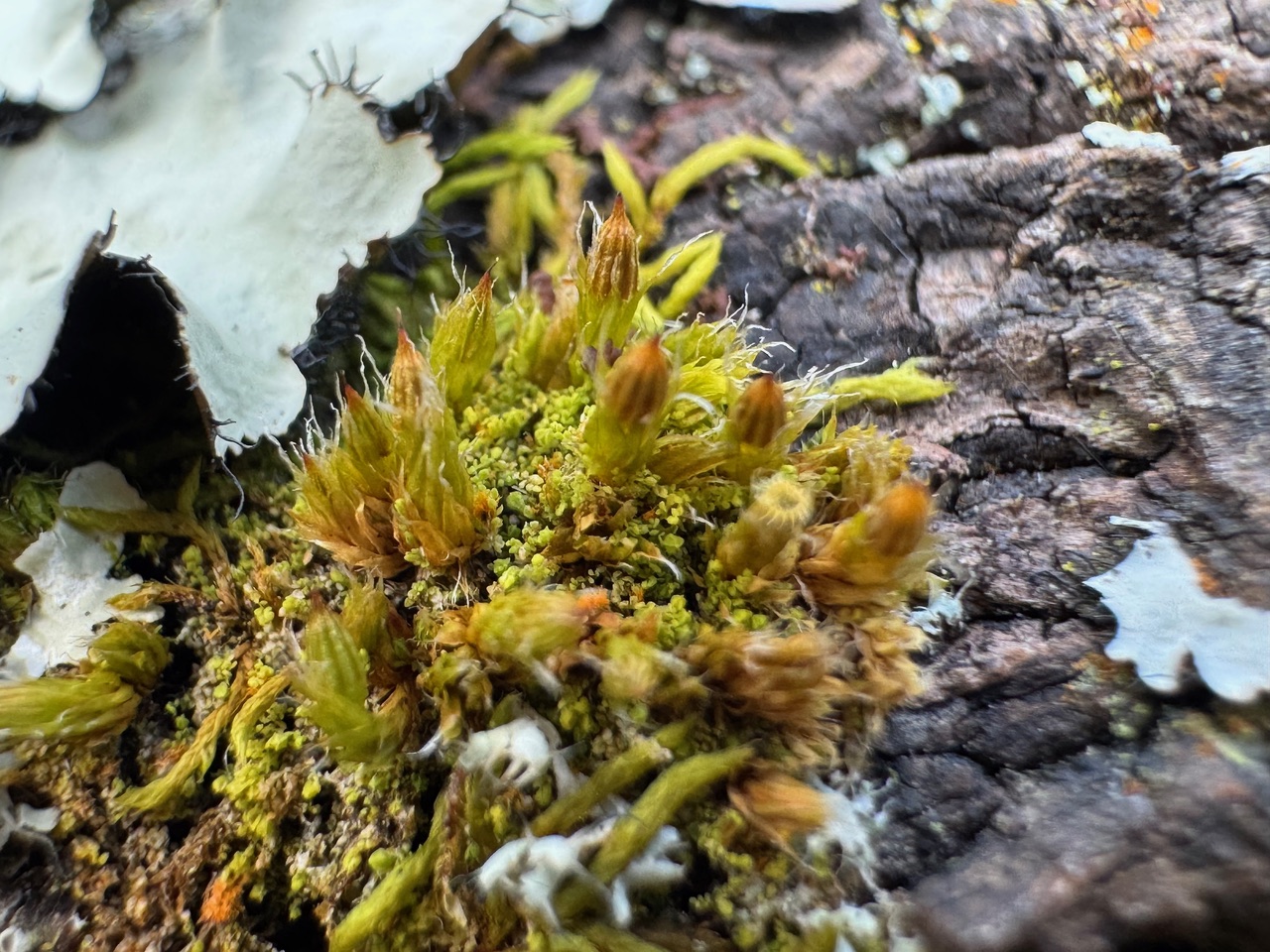
Top: Orthotrichum diaphanum with Myriocoleopsis minutissima threading through it. (Lynne Goble)