[ccfic]
Article by Debbie Welham
Photos by Mark Wright
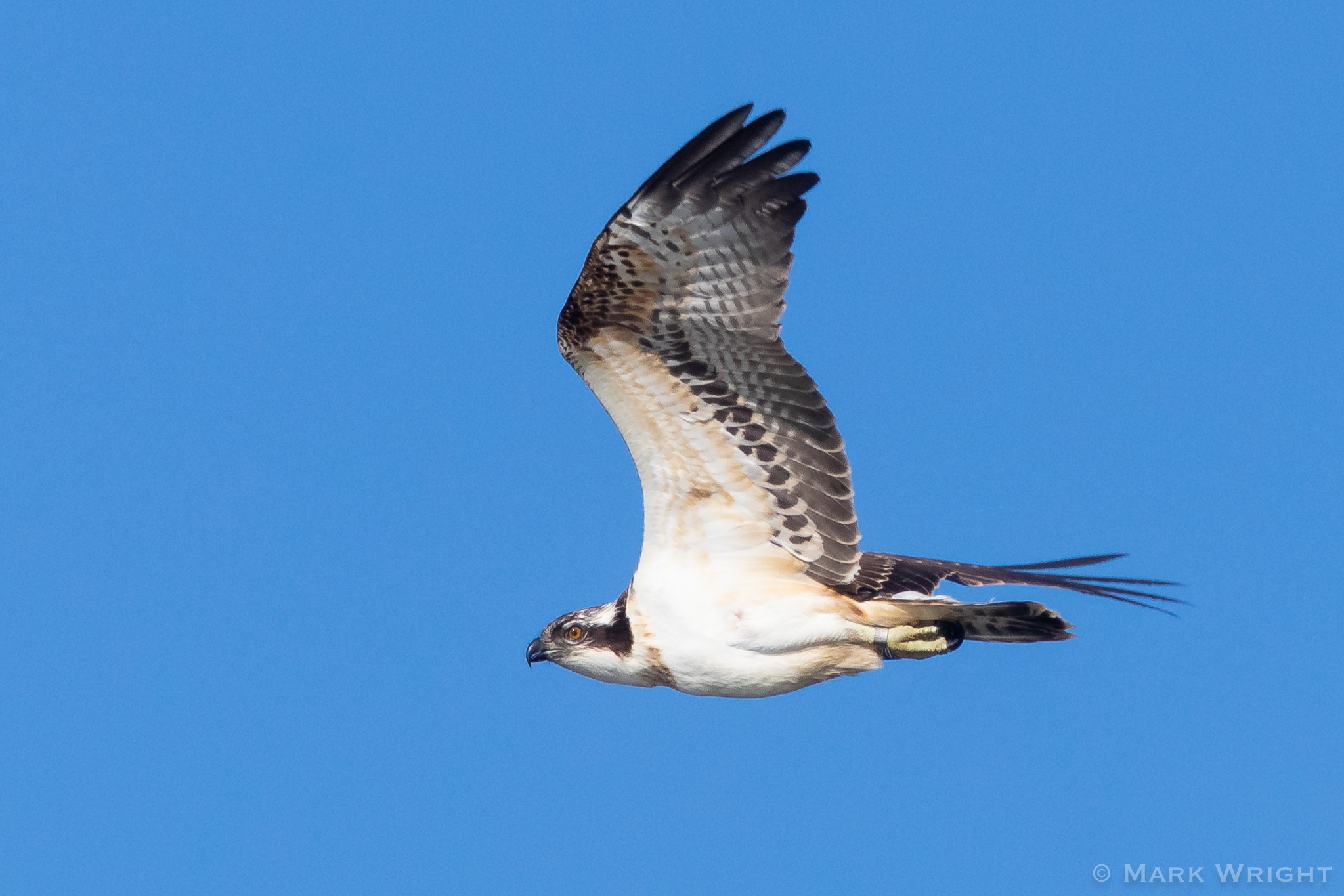
I spend a fair amount of my spring and summer (and, technically, autumn) almost permanently attached to my binoculars, looking out excitedly for a particular bird. The Osprey. They are sizeable birds, brown and white in colour with a wingspan of around 1.5m, and, as with many birds of prey the females are bigger than the males. They have a fabulous brown eye mask, long narrow wings, and the females have stronger brown markings like a necklace on their breast and beautifully patterned underwings. The males are often plainer on chest and underwing (though all the birds are different and for avid watchers the patterns can be good for identifying individual birds). Unlike the gulls, which it might be easiest to mistake them for, Ospreys hold themselves in a distinctive hover while they investigate a fishing spot. Sometimes their fishing expeditions are a quick purposeful fly in, a single dive, a catch, a shake of the water droplets from their feathers and off. Could be all over in less than 90 seconds. Often there are several aborted dives and empty splashes before there is the silvery glint of a fish being manoeuvred into position, to be taken to a suitable eating spot. Ospreys only eat fish, and it’s barely believable to me that they can even lift some of the huge fish out of the water & then fly.
I enjoy watching all birds but for me, every year since 2019, by the middle of March a whole different level of anticipation has crept in. Will ‘our’ ospreys be back? And I know I am not alone. I bump into a lot of people who know off by heart the dates ‘our’ ospreys have got back in previous years. It’s an anxious wait for that first return, followed by even more anxious waits as the osprey season unfolds. Will they both make it back? What love triangle shenanigans might there be? How many eggs will be laid? When will they hatch? Will there be black plastic in the nest? Are they all ok? From March to late August there is a lot of osprey energy, then somehow all of a sudden it’s autumn and, as the wigeon and teal and spoonbills and avocets become more obvious sights in the harbour, the talk is of how many days it is since the last osprey sightings and do we think they have left.
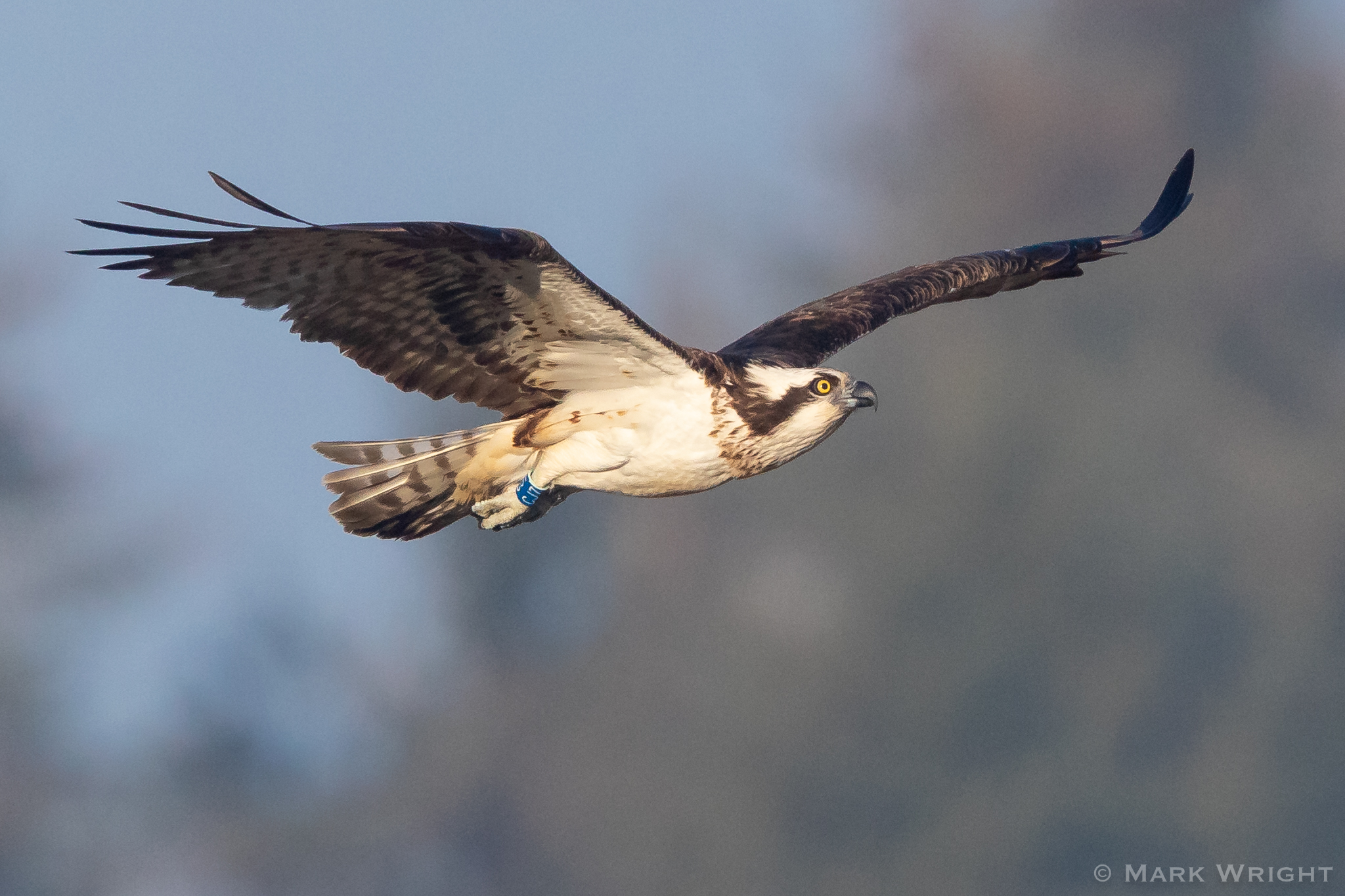
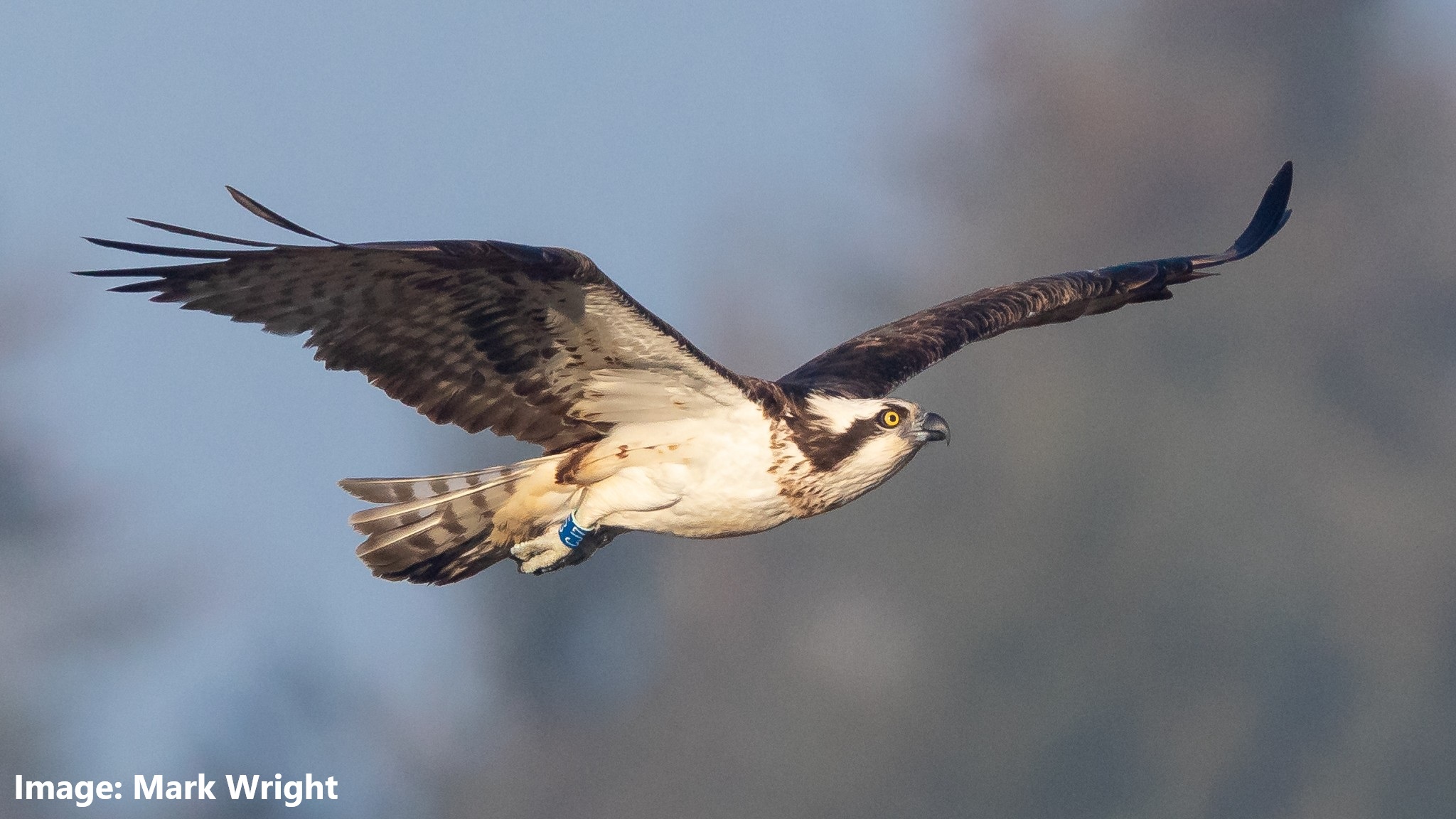
In spring 2020 while one worldwide crisis was underway, another more local drama was playing out in Poole Harbour. On April 2nd 2020 a female osprey known as CJ7 (because of the identifying code on the blue ring on her right leg) arrived on a nest platform in the harbour. Ospreys spend the winter in Africa, in The Gambia and Senegal, and the males and females overwinter apart. CJ7 was back in the harbour awaiting the arrival of LS7 the male she had bonded with the previous year. He was a young bird and it’s quite common for them to return later in the spring from their migration. However, as the weeks ticked away it became clear that LS7 hadn’t made it back. CJ7 continued alone on the nest and laid unfertilised eggs. All of this was observed (while self-isolation and social distancing was becoming the new normal) because of a webcam on the nest platform. CJ7 has a very special place in many people’s affections from that lockdown spring. I didn’t know then that there was a long-established expert base for ospreys in the area, but I knew that there was only the possibility of a local osprey nest because of a translocation project run by Birds of Poole Harbour and the Roy Dennis Wildlife Foundation.
The wider Poole Harbour area – Lytchett Bay, Holes Bay, Brands Bay in Studland, the Wareham Channel and Middlebere Channel (either side of the Arne peninsula) are places ospreys fish on their migration routes. Some stay in the area for several weeks & others just make fleeting visits. In mid to late August, as ospreys who nested further north in the UK make their way on migration, there are great opportunities to see ospreys passing through the area. But, until 2019, when CJ7 and LS7 bonded and started making a nest their own, no ospreys had bred in the harbour for two centuries.
Ospreys were not absent from such a suitable habitat voluntarily – human persecution and egg collecting played a large part in eradicating them. Then there are the ospreys own natural instincts to consider. Ospreys are drawn to other ospreys and male ospreys want to nest near the location they fledged from, so their absence is a cycle that is hard to break without intervention. CJ7 who fledged from a nest in Rutland had been drawn to the harbour by the presence of the young birds from the translocation project. I have also seen ospreys in other countries (there are 4 subspecies around the world), even nesting on lampposts in car parks with humans walking right by them, but that’s not the case here. Ospreys here are very sensitive to disturbance and will abandon an unsuitable nest site. A lot of complex components have to come right (or be made to come right) for ospreys to be here. Every time I see an osprey I still get excited, it doesn’t matter how many times I have seen that wing shape, and double checked that it’s not a great black backed gull, and then seen the tell-tale hover or steep descent towards the water, it’s still magical.
As for many other ospreys, a lot has to work out favourably for CJ7 to nest, eat, and be fit to leave on migration in late August (as she did in 2020) and to make it back the following year. CJ7 arrived back on 1st April in 2021 (so not too many sleepless nights for worried watchers) and in May 2021 it became clear that another mate was on the scene. Local osprey 022 from the Poole Harbour translocation project. The rest, as they say, is history (all widely documented on the Birds of Poole Harbour website). And it is a historically amazing nest. 022 is a fantastic provider of fish, and the pair has raised 4 chicks a year for the last 3 years – which might be the only known nest ever to do so in the UK.
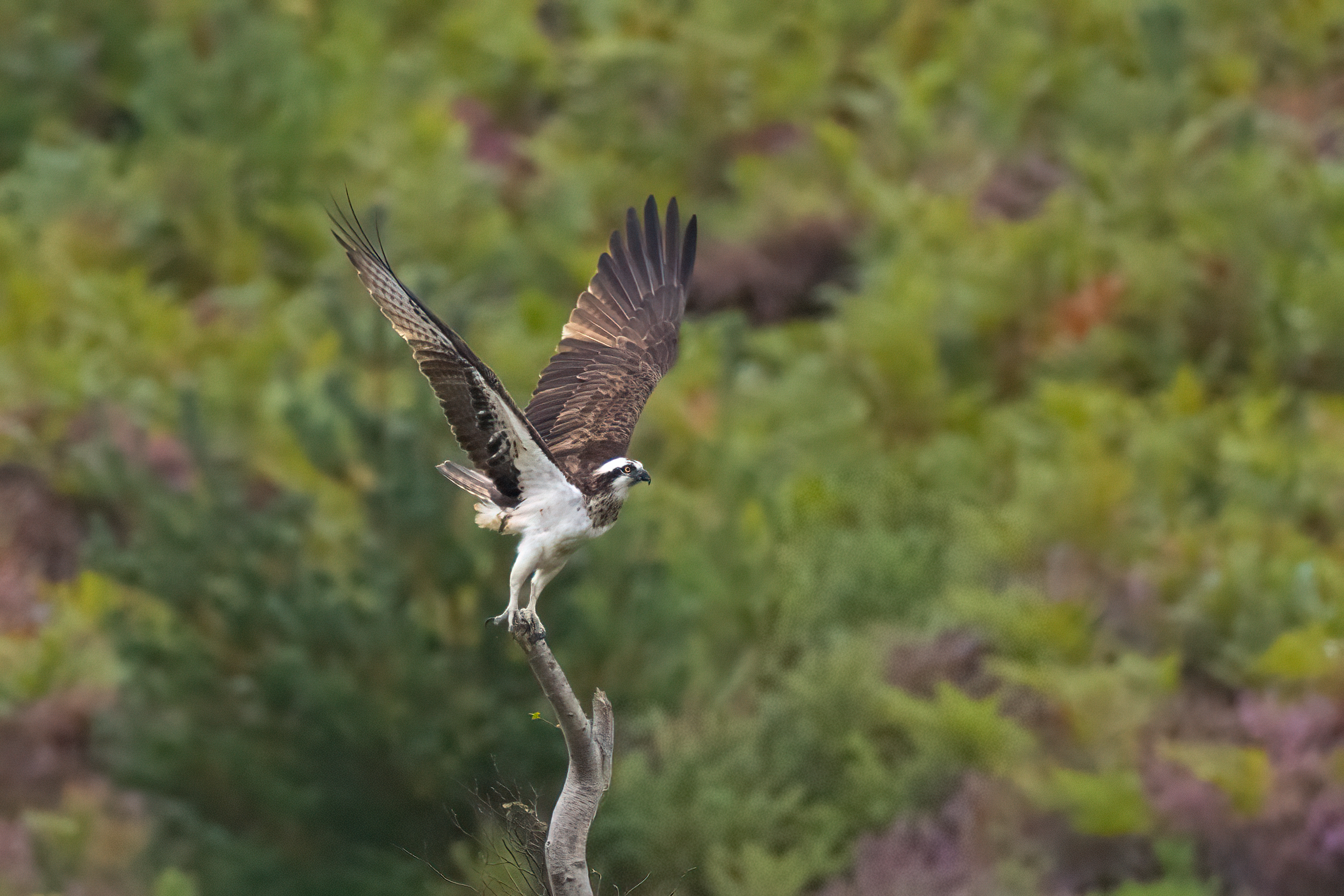
I am luckier than many other of CJ7 and 022’s admirers because I live here (and I also volunteer for Birds of Poole Harbour) and I don’t only watch them on the fabulous webcams, though I do that too. Following in a long tradition of ensuring that osprey nest sites are protected by the collective attention of many people who care about the birds, Birds of Poole Harbour decided to make the nest location public knowledge. CJ7 and 022’s nest is visible from a viewing platform at Carey’s Secret Garden. There are bookable tours in the osprey season, which limits visitor numbers and avoids disturbance. There are free osprey watch ‘pop ups’ and 2 osprey viewing boats a day out in the harbour during the August peak of ospreys movement. But, with or without a boat or your binoculars, any time between April and September anywhere around the shore from Swineham in Wareham, and all along the Wareham channel, from new viewing platforms at Ham Common and Lytchett, there is a chance of seeing ospreys & more and more of them. There are now young male ospreys who have fledged from the Carey nest returning to try and establish nearby nest sites of their own; females drawn to the other ospreys; territorial disputes (022 has no intention of giving up any of his fishing rights easily); displaying; new pairs forming; youngsters from the Carey nest getting used to their wings and realising they really are going to have to get their feet wet if they want to eat. There are migrating ospreys drawn to other ospreys and finding places to fish in the harbour. In another change to our local bird landscape, it turns out that the white tailed eagles who have established themselves in the area (after a translocation project reintroduced them to the Isle of Wight), are quite partial to stealing fish from ospreys. In other news, eagles don’t leave for winter, so now I have no reason to be detached from my binoculars at all.
Reading:
All things local osprey –
Really all things osprey –
Tim Mackrill, The Osprey