[ccfic]
Dragonfly Recording in South East Dorset
A two-century chronicle of amateurs, scientists & citizens
By Kevin Edge
Bins, clipboard, camera, action!
AS I WRITE THIS ARTICLE, my mobile phone lights up with a short message:
Lge red damsel fem.
lytchett bay today,
my first of the year.
It is 22 March, 2026 and a hawk-eyed member the Purbeck Natural History Forum (PNHF) has shared – via WhatsApp – their sighting of a female Large Red Damselfly (Pyrrhosoma nymphula) at Lytchett Bay, Dorset. The surfacing of Large Red Damselflies means it must be springtime and the start of a new Odonata recording season. Having received that PNHF group text, ecologists and volunteers in the Purbeck area – like keen Odonata recorders everywhere – will be dusting down binoculars, reaching for clipboards, cameras and field guides.
So, what kind of natural history exercise is this? It is a true scientist-citizen effort bringing people together to spot and log adult Odonata seen on the wing at local sites. But why focus those binoculars on dragonflies and damselflies in particular? Well, they are colourful, easy-to-see ‘bioindicators’. They give ecologists those all-important freshwater habitat data sets and read-outs that can guide habitat management.
This impulse to watch and record these insects is not unique to our own eco-conscious era. It is one that stretches back two centuries. This article spotlights just a few of the dedicated people from previous eras who have got up close to the Odonata of South East Dorset.[1]
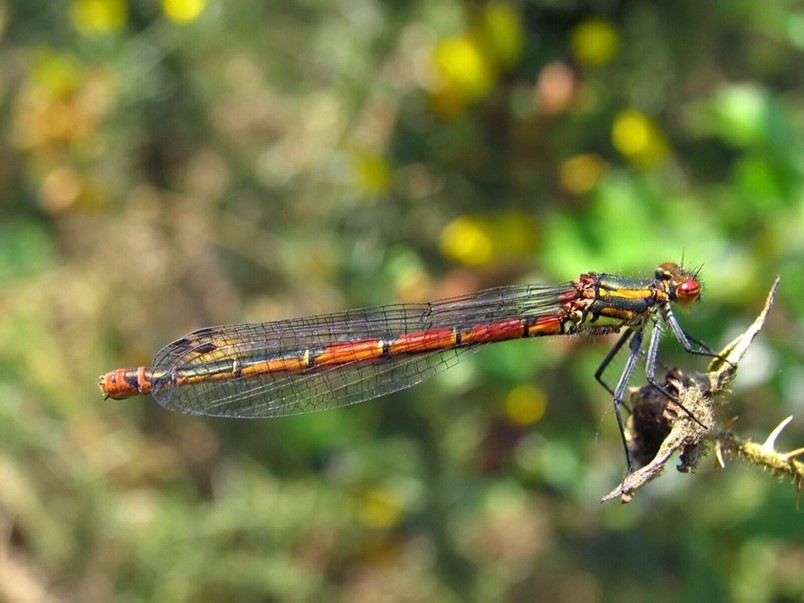
Large Red Damselfly (Pyrrhosoma nymphula), female, form typica. It has a more evocative epithet in Ireland: the Spring Redtail. Dave Kitching | BDS
[1] The Pool Basin cover about 28% of the modern-day county of Dorset. This post-glacial lowland in the South East of the county is cut by rivers and ditches, mired by bog and fen, pitted with flooded mineral quarries and holed with fire ponds and bomb craters. Together these freshwaters form an array of highly suitable Odonata breeding habitats. They are pitstops for generalists, havens for specialists and new homes for newcomers.
“ In the Cabinets of Mr. Dale and the Author ” Curtis (1886), Plate 616 text.
JAMES CHARLES DALE (1791-1872) of Glanville’s Wotton, Dorset was one of the most prominent amateur entomologists of his era. He is best know for his discovery of the Lulworth Skipper (Thymelicus acteon) at Durdle Door, Dorset in 1832. As Squire and High Sherrif, Dale belonged to the ‘prosperous middle of society’ with surplus time and money. He combined traditional collecting to impress with a wish to classify and learn.
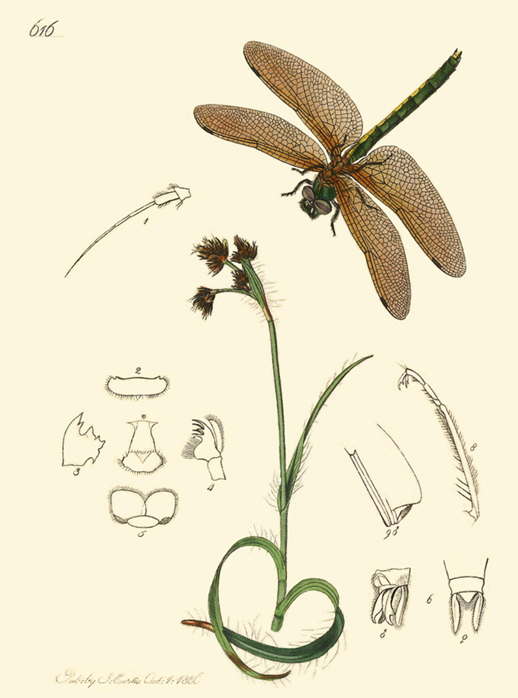
Orange-spotted Emerald Dragonfly (Oxygastra curtisii Dale) Plate 616 John Curtis, British Entomology: Being Illustrations and Descriptions of the Genera of Insects Found in Great Britain and Ireland, 1836 | Delta-intkey.com (2026).
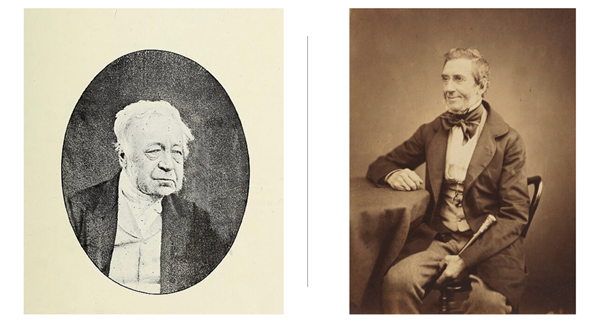
J. C. Dale (left) and John Curtis met in London’s top circle of zoologists and amateur naturalists. They became friends and colleagues. | Wikimedia Commons (2026) Dale and Wikimedia Commons (2026) Curtis.
For a moment let us imagine Dale in the saddle crossing the sunny Dorset countryside in pursuit of insects. He would be skirting wet heathland and fording streams; he would stop to water his horse at village ponds. He must surely have been entranced en route by Demoiselles, Chasers, Darters and Hawkers. Once home, Dale would make entries in his nature diary noting the ‘what, where, when and who’ – key facts recorders still provide today to aid verification.
In 1820 Dale discovered the first British specimen of the Orange-spotted Emerald Dragonfly – (Oxygastra curtisii Dale). He caught it near his Parley Heath Farm (then Hampshire) where the Moors River flows into the River Stour. A second was then seen at Hurn, Dorset. Friend, fellow amateur entomologist and illustrator JOHN CURTIS (1791-1862) later wrote
“ This fine species [(Oxygastra curtisii] … was discovered by Mr. Dale on Parley Heath the 29th June, 1820, and subsequently at Hurne in Dorsetshire as late as the 16th July. On the 8th June, 1831, I captured a specimen on the side of Ramsdown near Heron Court, [Christchurch] in company with Mr. Dale, who soon after described it in Loudon’s Magazine under its present name.” (Curtis,1836).
In 1834 Dale generously described and named the species after his in-the-field friend Curtis who later illustrated it beautifully in his sixteen-volume work British Entomology. Sadly, the last British record of the Orange-spotted Emerald was on 19 July, 1963 in the vicinity of the Moors River, Dorset and is now extinct in Britain. Might Dorset ever see its reintroduction or natural recolonisation?
Dale and Curtis were never just dilettantes. Indeed in 1830, Dale had already amassed 120 drawers of British insects, including four devoted to Odonata. Dale and Curtis together brought process and precision to their entomology.[2]
Nature could be literally ‘pinned down’ in cabinets. But it could be ‘pinned down’ too in scientific publications using the Linnaean binomial system of genus and species. Ambitious amateurs like Dale had a template in which to write detailed anatomical descriptions, invent names and submit dead type specimens to reference collections.
[2] Dale’s insect collection is to be found at Oxford University, in the Hope Department of Entomology having been bequeathed by his son, Charles William (1852-1906) an equally keen Dorset entomologist.
Habitats & habits: The ecological turn
The nineteenth-century practice of listing county species had merit, but the rash netting and trading of dead insects – never fully abandoned even by the likes of Dale – was to be challenged at the end of the century by new concerns. What would eclipse a love of showy cabinets for many would be more time spent in the field; more time asking questions about an organism’s viability in a distinct habitat. The new discipline of ecology was emerging.
But ecology was no dispassionate science. What progressive scientists and naturalists witnessed gave rise to concerns about human impacts on nature. Hints of this are seen in the life of amateur naturalist EMMA SARAH HUTCHINSON (1820 – 1905). In the 1880s, she observed that the numbers of the Comma Butterfly (Polygonia c-album) were falling. As a result, she oversaw the rescue of its larvae and pupae from her local Herefordshire hop fields before post-harvest burning. Moreover, Hutchinson addressed the collecting community of her day and “suggested that instead of simply collecting butterflies they might study their ‘habits’.” (Salmon et al 2000, p. 160).
This disciplinary turn to a value-charged study of wildlife communities and ecosystems crystalised in 1913 when botanist SIR ARTHUR TANSLEY (1871-1955) founded The British Ecological Society (BES).
Please do not build on Studland!
Only a century after Dale officially named the Orange-spotted Emerald Dragonfly, President of the BES CYRIL DIVER (1892-1969) stepped forward to protect the wildlife of Studland Heath on the Isle of Purbeck. Anxious that there could be building on the sensitive ecosystems of that peninsula, ex-Royal Navy officer Diver marshalled his volunteers to generate extensive field records (1932-39). This was his way of showing that this place was vital for Dorset nature.
In The Dorset History Centre Archive are maps, data and photographs compiled during that series of summers on the peninsula.
Here is a typical catalogue entry:
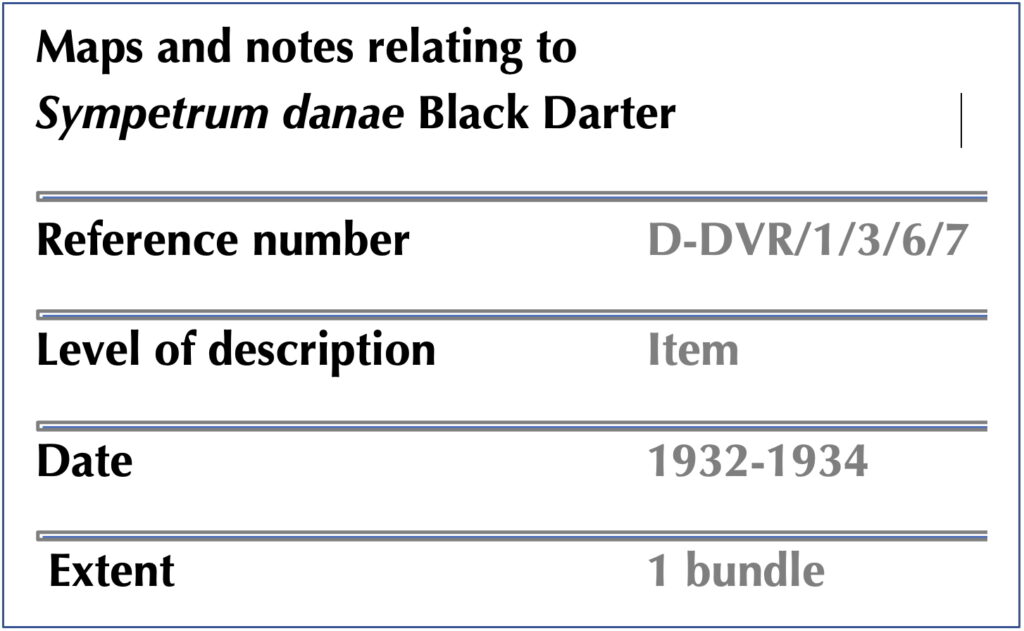
Dorset History Centre Archive Catalogue, (2026)
Odonata were not at the heart of Diver’s project, but they were the alluring macro inverts his helpers were drawn to and there are notes relating to some 18 species. We read that: “Diver and his group saved the site from development; recording 2,500 species including bees, butterflies beetles and birds”. (Dorset History Centre, 2020).
Disciplined recording was becoming a key conservation tool.
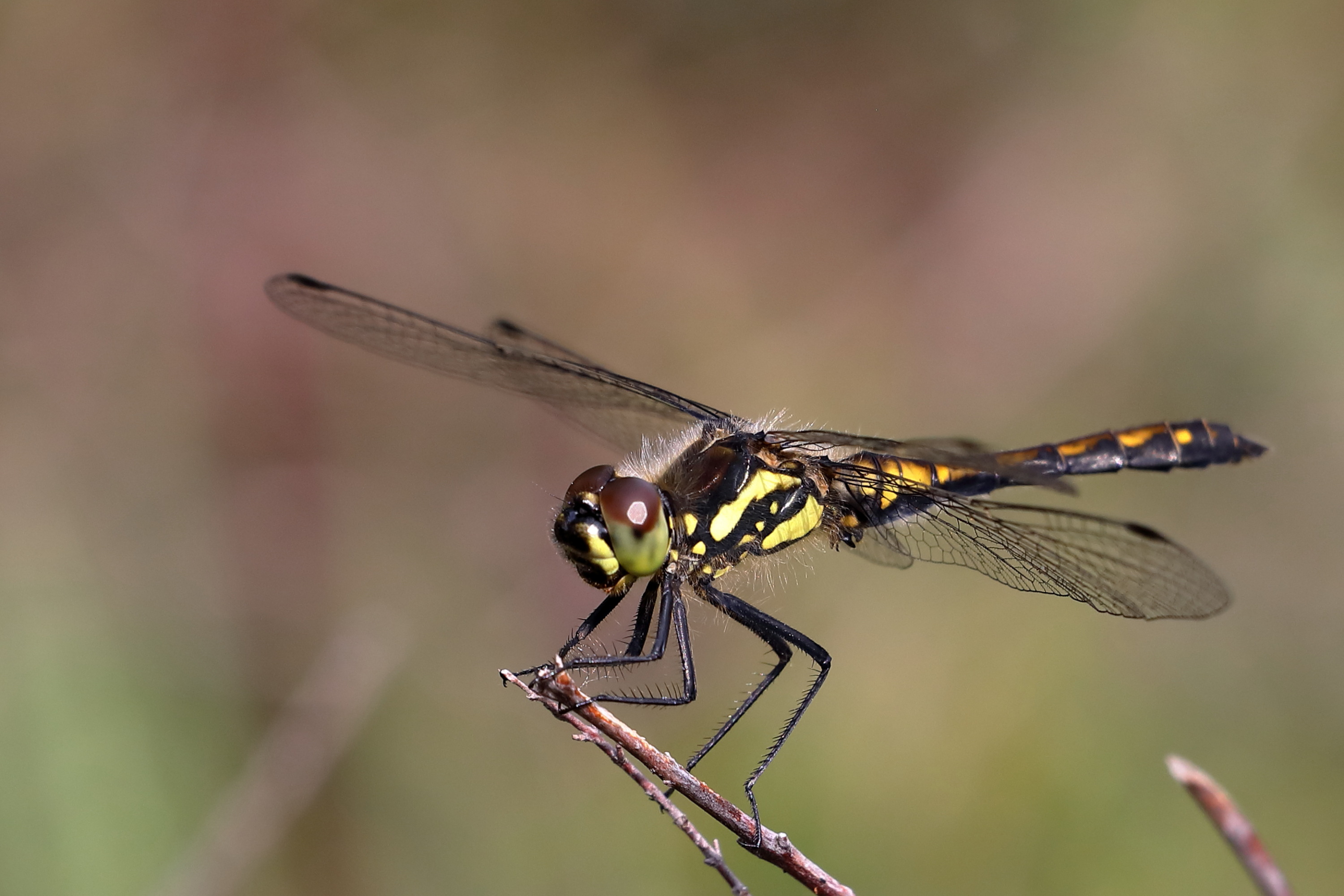
Black Darter (Sympetrum danae), female |© Terry Bagley
Purbeck Bomb craters & ball-clay pits
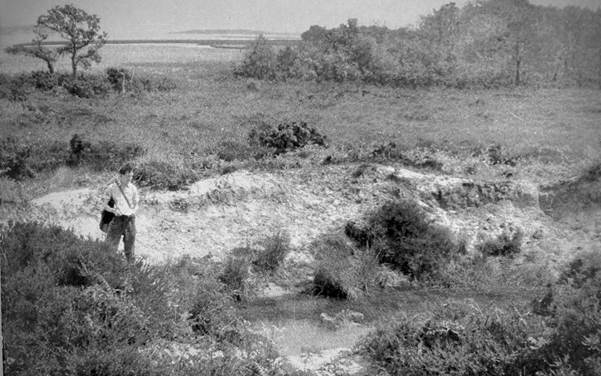
Water-filled bomb crater, Arne Heath, Dorset | Corbet, Longfield & Moore, (1960), plate VII. Photo: A. P. Tuck.
NORMAN W. MOORE (1923-2015) was a noted British Odonatologist. In 1953 he joined Nature Conservancy and was posted to the Institute of Terrestrial Ecology Station, Furzebrook in Purbeck. From 1954-1960 he undertook studies into inter- and intra-specific competition and ‘highest steady densities’ of Odonata in the water-filled Bomb craters of Purbeck’s Arne Peninsula. With methodical field research Moore modelled Odonata hierarchies and homing traits. He also laid down baseline Odonata records for those craters logging a total of some fifteen species including the Black Darter. In 2002 he returned to RSPB Arne to see the consequences of what he termed the ‘seral development’ of pond vegetation. He reported that at RSPB Arne
“All the 15 species of dragonfly present from 1953 to 1960 are still present but there are indications that the Southern Hawker (Aeshna cyanea) has increased at the expense of the Common Hawker (Aeshna juncea). The Migrant Hawker (Aeshna mixta) which was never recorded between 1953 and 1960, is now commonly observed. Thus at Arne we have evidence of the relative stability of the dragonfly fauna of small heathland ponds as well as evidence of changes in the status of three aeshnid species.” (Moore, 2003, 4-5).
Conservation concerns deepened in the last quarter of the twentieth century with Odonata gradually being redefined bioindicators: dynamic water quality sentinels and environmental bellwethers. As Odonata expert Michael Samways has written: Odonata “are important targets, tools and model organisms for conservation action.” – Samways et al (2025, pp. 1-2). This instrumental move is sometimes called ‘applied odonatology’ (Bried and Samways, 2015).
An example of Odonata being used in the Isle of Purbeck to measuring human impact can be seen in the work of freshwater ecologist LAURIE E. FRIDAY. Her 1983 and 1987-8 surveys of flooded ball-clay pits of Purbeck examined the correlations between water pH and assemblage diversity. Friday selected 16 ponds. She concluded
“These ponds vary widely in chemistry [and] had diverse dragonfly fauna”. Friday added “Collectively these ponds make a positive contribution to the ecology and landscape diversity of the Isle of Purbeck.” (Friday, 1988)‘
Diver Project 2.0 & Back from the Brink
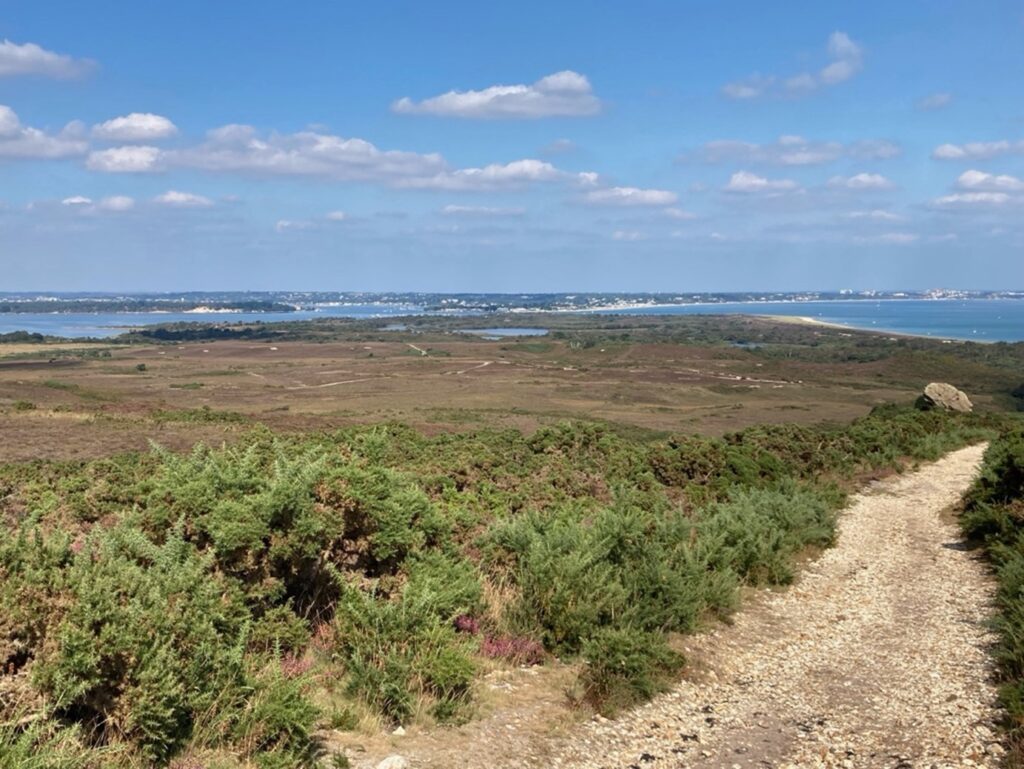
Eastern arm of the Purbeck Heaths NNR: Studland peninsula (middle distance) and Brownsea Island viewed from Godlingston Heath | Kevin Edge
From 2013 to 2015, the Diver project was rebooted by a new generation of scientists and citizen volunteers coordinated by the National Trust. Recorders returned to Studland’s dunes, heath and Little Sea documenting their plants and animals and revealing eight decades of successional change.
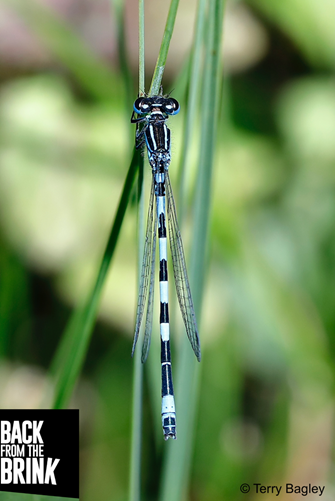
Southern Damselfly (Coenagrion mercuriale) | Courtesy Terry Bagley
From 2017 to 2021 a national project ran to monitor vulnerable species. Named Back from the Brink it comprised a number of regional schemes, one of which was Dorset’s Heathland Heart operating in South East Dorset.One of its targets was the endangered Southern Damselfly (Coenagrion mercuriale). Peak counts of the males were carried out by trained citizen scientists at several key sites including the fen arm of Hartland Moor.
Both projects provided inspiration for the formation of the Purbeck Natural History Forum in 2022. Initially this coordinating body only operated across the new Purbeck Heaths National Nature Reserve (PHNNR). Volunteers’ groups were set up, including one for Dragonfly & Damselfly Recording. Routes and recording protocols for PHNNR Grazing Unit and control-area Odonata surveys were scoped and planned by National Trust ecologists MICHELLE BROWN and GEN CRISFORD and entomologist LORRAINE MUNNS. Southern Damselfly recording also continues today with PNHF recorders maintaining the original Back from the Brink protocols.
PNHF Odonata volunteers have since been called on to record at other sites in the area. There has been baseline surveying for the Wareham Arc project – an important landscape recovery scheme and there are also plans for complete species listings on two Purbeck mire sites, to help monitor the Dorset Peat Partnership’s recent restoration activities.
Fire & water
In 1864 J. C. Dale wrote a letter to the Reverend T. Blackmore
“I would go through fire and water for insects.” (Insect Collectors’ Forum, 2015)
He was ready – metaphorically – to face every extreme in his searches. The issue today is whether insects themselves – particularly those with an aquatic life stage – can survive the realities of rising temperatures and the more frequent floods of a changing climate.
Heathland ponds may not always dry completely, but research suggests warmer waters are a challenge for larvae of cold-adapted species like the Black Darter. Is it time to dig deeper, cooler ponds? Any citizen science evidence of Black Darter breeding in the valley mires of Hartland Moor and Greenlands in Purbeck will be significant in this context.
And what about flowing water species like the Demoiselles and the Golden-ringed Dragonfly? Will sudden torrents scour river and stream beds that are home to their larvae? Will they be flushed downstream or be stranded in fields when waters recede?
Arguably, collective efforts of passionate experts and knowledgeable amateurs everywhere are shot-through with age-old curiosity, rigour and protectiveness. Such attentive field observations give on to data which are surely the lifeblood of today’s ecology and habitat management.
So, can we citizen scientists in South East Dorset be like Dale and pick out unexpected species expanding their range like the Williow Emerald Damselfly (Chalcolestes viridis) moving west across the county; or the continental, warm-adapted Scarlet Darter (Crocothemis erythraea), hitherto a vagrant which may be breeding successfully near Crossways, Dorset?
Can we be like Diver and show our love of place with spreadsheets that argue for their protection? Like Moore and Friday might we monitor specific ponds – short and long term – with a view to assessing the impact of grazing on habitat quality and the logging of their Odonata assemblages?
So, it really is time to knock the rust off our Odonata ID skills. It is time for all who love Dragonflies to show up; time to spot for ourselves a new-season Large Red.
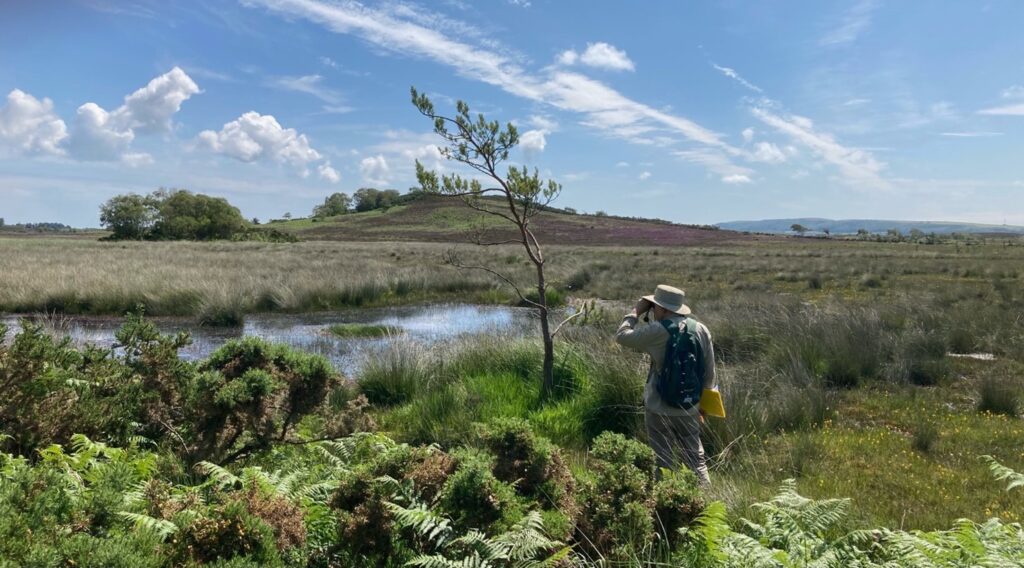
Hartland Moor mire | Kevin Edge
Special Thanks to Terry Bagley, Katie Coombs, Jasper Iepema and Paul Swann.
Copyright © 2026 Kevin Edge & The Purbeck Natural History Forum.
References
Bried and Samways (2015) Jason T. Bried and Michael J. Samways (2015) ‘A review of odonatology in freshwater applied and conservation science’ DOI: 10.1086/682174. Received 10 April 2014; Accepted 25 November 2014; Published online 19 May 2015. Freshwater Science, 2015. 34(3):1023–1031.
Friday (1988) L. E. Friday: ‘The Conservation and Amenity Value of ball-clay ponds in the Isle of Purbeck, Dorset, UK in Biological Conservation Vol., 43, Issue 3, 1988, pp. 165-180.
Corbet, Longfield & Moore (1960) Philip S. Corbet, Cynthia Longfield and N. W. Moore, The New Naturalist Dragonflies. Collins, London.
Curtis (1836) John Curtis: British Entomology: Being Illustrations and Descriptions of the genera of Insects Found in Great Britain and Ireland.
Dorset History Centre (2020) https://news.dorsetcouncil.gov.uk/dorset-history-centre-blog/2020/11/06/revisiting-the-cyril-diver-collection [Accessed 29.3.2026].
Dorset History CentreArchive Catalogue (2026) https://archive-catalogue.dorsetcouncil.gov.uk/records/D-DVR/1/3/6/7 [Accessed 29.3.2026].
Delta-Intkey.com (2026) DEscription Language for TAxonomy: https://www.delta-intkey.com/britin/images/bent616.jpg [Accessed 23.3.2026]
Insect Collectors’ Forum (2015) https://collector-secret.proboards.com/thread/512/dale-fire-water-insects [Accessed 228.3.2026].
Moore (2003) Norman W. Moore, ‘Four long term studies on dragonfly populations’ in Journal of the British Dragonfly Society, Volume 19 No. I & 2, 2003, 2-7.
Salmon et al, (2000) Michael A. Salmon, Peter Marren & Basil Harley, The Aurelian Legacy: British Butterflies and their Collectors, University of California Press.
Samways et al, (2025) Samways, M. J., Córdoba-Aguilar, A., Deacon, C., et al, ‘Scientists’ warning on the need for greater inclusion of dragonflies in global conservation’. Insect Conservation and Diversity. Royal Entomological Society (2025) 1-20. https://resjournals.onlinelibrary.wiley.com/doi/10.1111/icad.12819 [Accessed 29.3.2026].
Wikimedia Commons (2026) Curtis https://commons.wikimedia.org/w/index.php?search=John+Curtis+entomologist&title=Special%3AMediaSearch&type=image [Accessed 28.3.2026].
Wikimedia Commons (2026) Dale https://commons.wikimedia.org/wiki/File:British_naturalist_James_Charles_Dale_(20230685780).jpg [Accessed 23.3.2026].