[ccfic]
In each newsletter, Meet the Forum will introduce you to one of the people behind the scenes or out in the field—those who bring energy, expertise, and enthusiasm to our shared work.
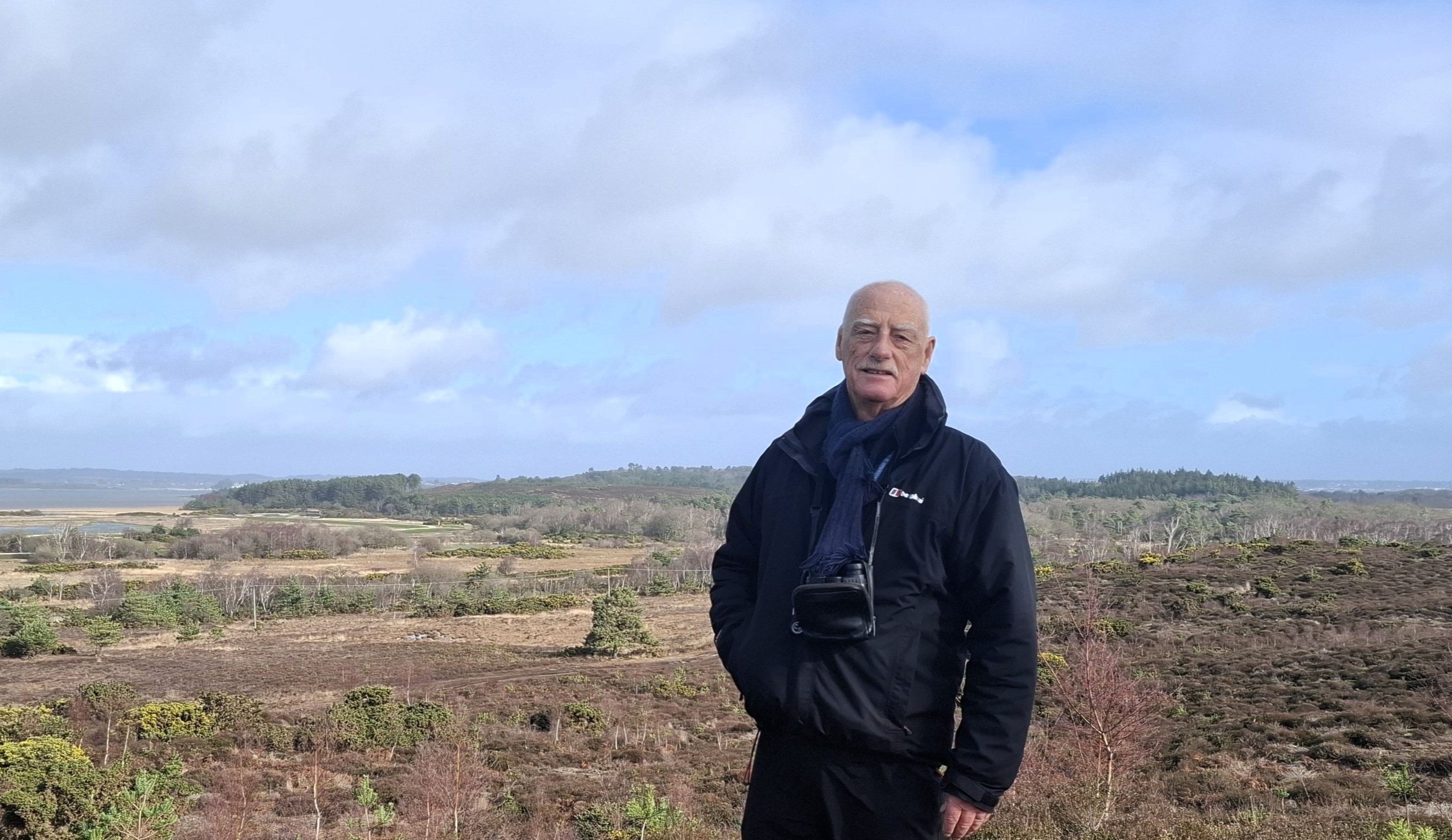
To launch this new feature, we are delighted to introduce Jim White, our dedicated Chair. Jim has been with the Purbeck Natural History Forum since its very beginning, and his contribution extends far beyond this role. He leads the Bryophyte Group and is a key driving force within the Botany Group, sharing his extensive botanical knowledge with others. This year, Jim has also played a leading role in establishing and guiding the new Lichen Group.
We asked Jim a few questions to learn more about what inspires and motivates him.
How did you first get involved with the Purbeck Natural History Forum?
I had volunteered throughout the three years of the ‘Diver Project’ and much enjoyed its peer-led approach to learning and recording. After the project ended, the ‘botany groups’ continued with flora recording across the entire NT Purbeck estate, including woodlands and the coastal grasslands. It was a further natural progression to PNHF when the super-NNR was established.
What sparked your interest in natural history or ecological recording?
Nature and wildlife have been a main interest since school days, and I’ve been very fortunate to spend my whole career working in nature conservation. Having worked for two different charitable bodies during 1970s, I moved to Dorset in1979 to work for Nature Conservancy Council and English Nature (precursors to Natural England). To fully protect and manage special sites for nature requires as much information as possible about the species of those habitats – an almost endless task and one where volunteers can really play an essential role.
What kind of surveys or activities are you currently involved in?
Botanical recording in particular, so working with the weekly botany group from April through to autumn, and in winter (when the weather allows!) the bryology group, recording mosses. Both activities operate across the NNR and on the wider NT estate, so giving the opportunity to visit and sample a great range of habitat types. I’m an occasional attendee of the waxcap fungi group and have started too with the newly established lichen group.
Are there any species, habitats, or locations you’re especially passionate about and why?
I have a strong interest and concern for grasslands because they are so dependent on continued appropriate management to maintain their rich flora and associated wildlife. Whether that is traditional livestock grazing or annual hay cutting, even a short lapse in those practices can lead to rapid decline and the potential loss of these herb-rich habitats. With such a varied geology and a strong history of conservation management, Purbeck still holds a fine range of important grassland sites.
Why do you think the work of the Forum is important—for Purbeck and beyond?
Purbeck, for its size, is arguably the most biodiverse area in England. We are so fortunate to have this wonderful richness of nature so readily available, but we carry too a responsibility to ensure it continues to thrive. PNHF is one of the ways that can be furthered, by marshalling the unique resource of so many interested and often expert naturalists who live here, both to carry out essential recording and monitoring, and to share their expertise, so that more and more volunteers can increase their own knowledge and confidence
What advice would you give to someone new to biological recording or conservation volunteering?
Sign up to several of the ‘groups’ operating under the Forum and try out some sessions to see which appeal most. Don’t worry if you don’t have much initial knowledge as there will be plenty of help and advice on hand from others. Everyone is keen to support and to mentor beginners! If you haven’t got a x10 hand lens, try to get or borrow one. It will open a hidden world of small but perfectly formed gems!
If you could spend a day surveying anywhere in the world, where would it be and why?
A quite impossible question! If I think about it for too long, I’m sure other ideas would leap to the fore; and it would probably change every few weeks! We really don’t live in a bad place anyway; after all, many would opt to come to Purbeck! But a habitat for which UK supports a disproportionate amount of the European resource (but not in Purbeck) is temperate rainforest. Those woodlands of the west, from the ancient ’dwarf’, misty oakwoods of Dartmoor, or the hazel woods of the west of Scotland, or deep, moist valleys of Wales; all so rich in mosses, liverworts and lichens. Mind you, I do rather like the sun too, so I’m glad this is only being cast away for a day!
See also: Meet the Forum: Debbie Welham – Purbeck Natural History Forum